

 en
en  English
 中文简体
中文简体 Español
 عربى
عربىWhat are the key differences between commercial and household refrigeration equipment?
 2026.05.01
 Industry News
Commercial refrigeration equipment refers to professional cooling and storage devices, mainly including commercial refrigerators, freezers, and display cabinets, exclusively designed for commercial scenarios rather than household use. It serves as the core infrastructure for cold chain storage, food preservation, and commodity display across catering, retail, supermarket, and institutional catering industries. Nearly 92% of global temperature-controlled food storage and display systems rely on such equipment, forming an indispensable basic support for the stable operation of the modern food circulation industry.
Different from household cooling appliances, commercial refrigeration equipment features larger storage volume, continuous stable operation, precise temperature control, and stronger structural durability. It can operate stably for a long time in high-frequency access environments and maintain a constant internal temperature to avoid food deterioration caused by temperature fluctuation. The overall market maintains steady expansion, with the global market scale maintaining a compound growth rate of around 5.4% to 6.5%, and the installed base of equipment worldwide has exceeded 38 million units, covering various commercial service scenarios.
The core value of commercial refrigeration equipment lies in extending the shelf life of perishable goods, complying with food safety management norms, improving commodity display effects, and reducing operational loss rates. It not only undertakes basic cooling and storage functions but also integrates display marketing, intelligent control, and energy-saving optimization, becoming an essential hardware facility for the profitability and standardized operation of catering and retail businesses.
Main Classification of Commercial Refrigeration Equipment
Classification by Functional Temperature Zone
According to the internal operating temperature range, commercial refrigeration equipment can be divided into three core categories, each with fixed application scenarios and storage objects.
- Refrigeration type: The internal temperature is stably controlled at 2°C to 8°C, suitable for storing beverages, dairy products, fruits, cooked food and fresh ingredients, meeting the fresh-keeping needs of short-term circulation commodities.
- Freezing type: The operating temperature is below -18°C, used for long-term storage of quick-frozen food, ice cream, frozen meat and processed frozen ingredients, effectively locking food texture and nutrition.
- Dual-temperature combined type: It integrates independent refrigeration and freezing areas, with separate temperature control systems for each zone, meeting the mixed storage demand of cold, fresh, and frozen goods in convenience stores and small catering shops.
Classification by Structural Form
Structural design determines the placement mode and space adaptability of equipment, covering mainstream styles suitable for different commercial spaces.
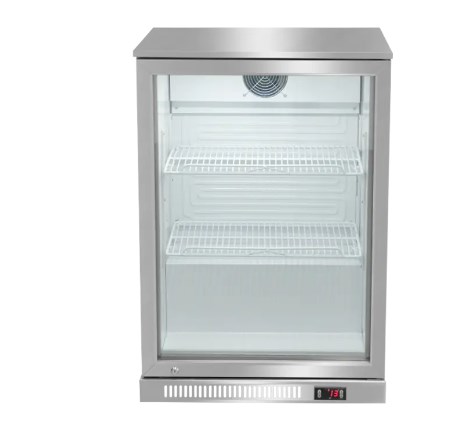
- Upright vertical type: Vertical cabinet body with glass door or solid door design, convenient for layered storage and item access, occupying small floor space, widely used in supermarkets and catering kitchens.
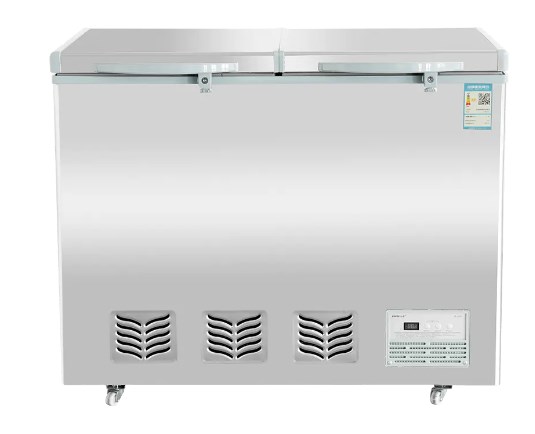
- Horizontal chest type: Flat top-opening structure, large internal storage space, good overall heat preservation effect, mostly used for bulk storage of frozen food in supermarkets and wholesale stores.
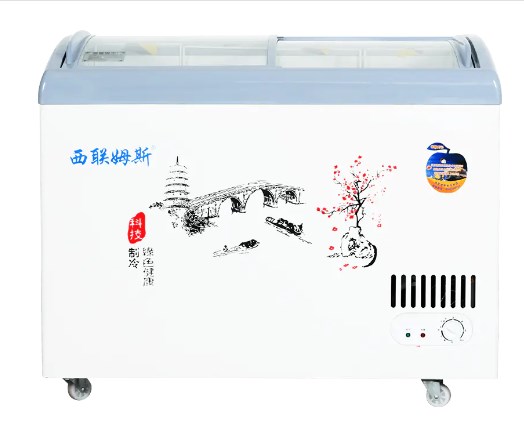
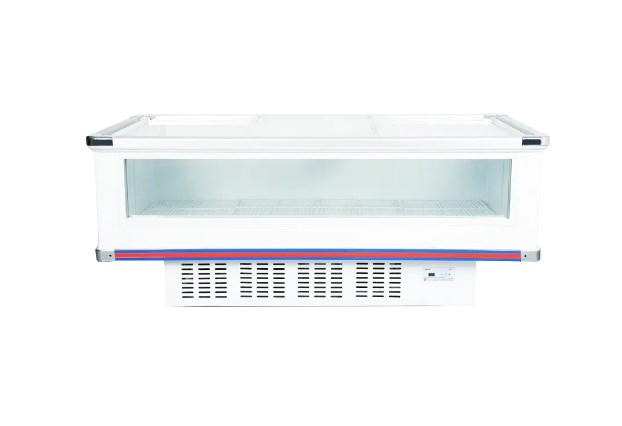
- Island display type: Open or glass cover integrated design, placed in the middle of the supermarket business area, with panoramic display effect, suitable for centralized display of quick-frozen products.
- Air curtain open type: No door design, forming a stable cold air curtain through circulating cold air, realizing convenient access, suitable for high-traffic convenience stores and fresh food sales areas.
Classification by Usage Scenario
| Equipment Type | Applicable Scenarios | Core Storage Objects |
|---|---|---|
| Kitchen Refrigerator | Restaurant, Hotel Kitchen | Fresh Ingredients, Prepared Dishes |
| Beverage Display Cabinet | Convenience Store, Cafe | Bottled Drinks, Dairy Products |
| Low Temperature Freezer | Supermarket, Frozen Food Shop | Frozen Meat, Quick-frozen Food |
| Cake Display Cabinet | Bakery, Dessert Shop | Cake, Pastry, Deli |
Working Principle and Core Structure
The basic working logic of commercial refrigeration equipment follows the vapor compression refrigeration cycle, consisting of four core links: compression, condensation, throttling expansion, and evaporation. The internal circulation of refrigerant realizes heat transfer, continuously taking away the heat inside the cabinet and maintaining a low-temperature and constant humidity environment.
The core components include high-efficiency compressor, condenser, evaporator, thermostat, and heat preservation cabinet body. The compressor is the power core of the whole system, providing power for refrigerant circulation; the condenser dissipates the heat released by refrigerant to the external environment; the evaporator absorbs internal heat to complete cooling; the precision thermostat controls the start and stop of the system to avoid temperature fluctuation beyond the standard range.
For display cabinet products, the air curtain technology is added on the basis of the basic refrigeration principle. The circulating cold air forms a barrier at the opening of the equipment, which not only ensures convenient access for customers but also prevents external hot air from entering, reducing cooling energy consumption by nearly 15% compared with ordinary open structures. The cabinet body adopts a thickened integral heat preservation layer and sealing structure, which effectively isolates external temperature interference and improves the stability of internal temperature.
In recent years, intelligent control modules have become the standard configuration of new commercial refrigeration equipment. The built-in sensing device monitors internal temperature and humidity in real time, automatically adjusts compressor operating power and air volume distribution, and realizes automatic defrosting operation, reducing manual intervention and avoiding equipment failure caused by manual operation errors.
Main Application Industry Distribution
Commercial refrigeration equipment has penetrated multiple commercial service industries, and the demand structure of each industry presents obvious differentiation characteristics. The retail industry accounts for 37.82% of the market share, ranking first in all application fields, followed by catering and hotel accommodation industries.
Retail Supermarket Industry
Supermarkets and convenience stores are the largest demand scenarios for commercial refrigeration equipment, requiring a full range of equipment such as upright display cabinets, horizontal freezers, island cabinets, and air curtain cabinets. It not only meets the fresh-keeping and storage needs of beverages, dairy products, fruits, and frozen food, but also relies on the transparent glass display design to enhance commodity display effect and stimulate consumers' impulsive consumption. The equipment needs to adapt to long-time non-stop operation and high-frequency door opening and closing access.
Catering and Hotel Industry
Restaurants, hotels, and catering central kitchens mainly use kitchen refrigerators and vertical freezers, which are used for classified storage of fresh ingredients, semi-finished products, and leftover ingredients. Strict food safety standards require equipment to have precise temperature control and good sealing performance to avoid cross-flavor between ingredients. Hotels supporting catering areas also need beverage refrigeration equipment to provide chilled drinks and breakfast, as well as fresh food display services.
Bakery and Fresh Food Industry
Bakeries, dessert shops, and deli shops adopt special cake display cabinets and fresh food refrigerated cabinets, which have higher requirements for temperature stability and humidity control. It can maintain the taste and appearance of pastries and cooked food for a long time, and the curved glass and layered design also improve the overall grade of commodity display, matching the high-quality consumption demand of the industry.
Cold Chain Logistics and Institutional Catering
Centralized canteens of schools, enterprises, and institutions need large-capacity commercial refrigerators and freezers for batch ingredient storage. Cold chain distribution terminals also rely on fixed commercial refrigeration equipment to complete the transfer and temporary storage of perishable goods, forming an important link connecting cold chain transportation and terminal sales.
Energy Saving Performance and Industry Development Trend
Commercial refrigeration equipment is one of the main power consumption equipment in non-residential buildings, accounting for about 60% of the total refrigeration power consumption of commercial buildings. Therefore, energy saving and emission reduction have become the core development direction of the industry. With the tightening of global environmental protection policies, high-efficiency energy-saving models have gradually replaced traditional high-power equipment.
The new generation of equipment adopts high-efficiency compressors, optimized heat dissipation structure, and high-density heat preservation materials, which effectively reduces comprehensive energy consumption. At the same time, environmentally friendly refrigerants are widely used to replace traditional high-pollution refrigerants, meeting international environmental protection standards and reducing the impact on the atmospheric ozone layer.
Intelligent networking has become an obvious development trend. Modern commercial refrigeration equipment supports remote temperature monitoring, operation data viewing and fault alarm reminder. Operators can grasp the equipment operation status in real time through terminal devices, realize predictive maintenance, reduce failure downtime, and further reduce operation and maintenance costs.
In terms of product design, integration and multi-temperature combination have become mainstream. A single device realizes partitioned storage of refrigeration, freezing and constant temperature fresh preservation, saving placement space for commercial venues and reducing the overall equipment procurement cost. At the same time, the appearance design is more diversified, matching the decoration style of different commercial stores, balancing practicality and ornamental value.
Selection Key Points and Daily Maintenance Guidelines
Core Selection Principles
- Determine the temperature range according to storage objects, select refrigeration type for daily fresh food, and freezing type for long-term frozen goods to avoid inappropriate temperature causing food loss.
- Match the volume and structure according to business scale and store space, choose vertical type for small space and horizontal or island type for supermarket area.
- Prioritize energy-saving certification models, reduce long-term electricity costs, and focus on the stability of the compressor and heat preservation structure to adapt to long-term continuous operation.
- Pay attention to sealing performance and defrosting mode. Automatic defrosting design can reduce manual maintenance frequency and keep the internal display clean.
Daily Maintenance and Maintenance Tips
Daily maintenance can effectively extend the service life of commercial refrigeration equipment and maintain a stable cooling effect. Regularly clean the condenser dust and internal cabinet dirt to avoid dust accumulation affecting heat dissipation and breeding bacteria. Check the door seal tightness regularly to prevent cold air leakage and increased energy consumption caused by aging seal strips.
Avoid overstocking items in the cabinet; keep a gap between goods for smooth circulation of cold air and uniform internal temperature distribution. Regularly check the temperature control system and operating noise. Once an abnormal temperature rise or loud noise is found, stop operation in time for inspection and troubleshooting to prevent small faults from expanding into large-scale failure losses.
For display cabinet equipment with air curtain structure, keep the air inlet and outlet unobstructed, regularly clean the internal circulating air duct, ensure the stable forming of cold air curtain, and maintain the balance of cooling effect and energy consumption. Regular professional maintenance every year can optimize the operation efficiency of the equipment and reduce the failure rate by a large margin.
Related News

Looking for Reliable Partner?
We are committed to becoming your most trusted partner.
Contact info.
 +86-153 0659 4509
 +86-(0)573-8796 5558
 zjxingbao@gmail.com
 No. 10 Baisha Road, Lianhang Development Zone, Chang'an Town, Haining City, Zhejiang China 314423
Mobile QR Code
Copyright © Zhejiang Xingbao Electrical Appliance Co., Ltd. All Rights Reserved. Custom Commercial Refrigerator Factory
