

 en
en  English
 中文简体
中文简体 Español
 عربى
عربىCommercial Display Cooler Guide: Temperature Bands, Sizing and Daily Running Costs
 2026.10.14
 Industry News
A commercial display cooler rarely fails mechanically first. It fails thermally: a glass door merchandiser that holds 3 degrees C on a quiet Tuesday drifts to 7.5 degrees C by Friday afternoon once the door has been opened 200 times a day and the condenser coil has not been cleaned since installation. Cabinet volume and price dominate most buying conversations, and neither number explains how the unit behaves across a real trading day.
This guide covers what actually decides performance: the temperature band the cabinet is rated to hold, the format that matches shopper behaviour, the share of gross volume you can actually sell from, the energy the cabinet will draw, and the build and certification checks worth running before you place a purchase order. Temperatures throughout are stated in degrees Celsius.
What a Commercial Display Cooler Is Actually Built to Do
A commercial display cooler is a refrigerated merchandiser engineered to hold pre-chilled packaged goods inside a defined temperature band while its door, or its open front, is disturbed hundreds of times during a trading day. That single sentence separates it from a household refrigerator.
A domestic fridge is designed around a closed door and warm food going in. A display cooler is designed around cold product going in and warm air coming back out, shift after shift. The compressor therefore runs long duty cycles, the evaporator is sized for recovery rather than quiet running, and the defrost schedule is tuned to clear the coil without lifting the cabinet above its band.
Working definition: the rating of a commercial display cooler refers to the temperature of its warmest test package, not to the number shown on the controller display. A cabinet sold as 2 to 8 degrees C must keep the warmest package at or below 8 degrees C in a Class 3 ambient of 25 degrees C and 60 percent relative humidity.
Two consequences follow. Pulling down warm stock is not the cabinet's job, and attempting it puts the rest of the load at risk for hours. Second, the controller probe reads air while the customer buys product: air can sit at 4 degrees C while a bottle at the centre of the top shelf reads 8 degrees C. Ask for load testing data rather than a probe reading.
| Product group | Target band | Acceptable drift |
| Dairy and fresh meat | 2 to 4 degrees C | plus or minus 1 degree C |
| Packaged beverages | 3 to 7 degrees C | plus or minus 2 degrees C |
| Cake, pastry and deli | 4 to 8 degrees C | plus or minus 2 degrees C |
| Wine and spirits | 8 to 14 degrees C | plus or minus 3 degrees C |
| Frozen display cabinets | minus 18 degrees C or lower | plus or minus 2 degrees C |
2-8 C core band for fresh food and beverage display
Class 3 rating point at 25 C ambient and 60 percent humidity
100-300 door openings a merchandiser handles per trading day
Bands shift by product category, and this temperature zone guidance for display coolers breaks the same numbers down category by category.
Glass Door, Open Air or Chest: Which Commercial Display Cooler Format Fits Your Store
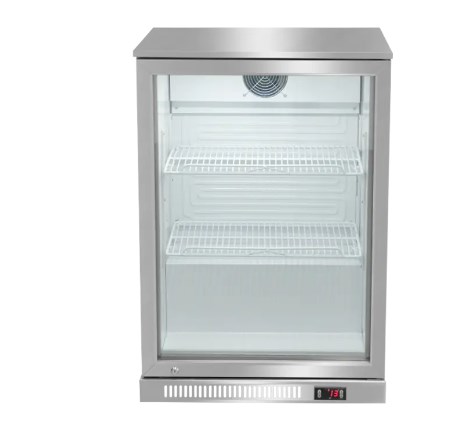
Choose the format from shopper behaviour rather than from litres per metre: self-service retail wants a glass door merchandiser, high-traffic aisles with constant restocking want an open air cabinet, and bulk chilled or frozen ranges want a chest.
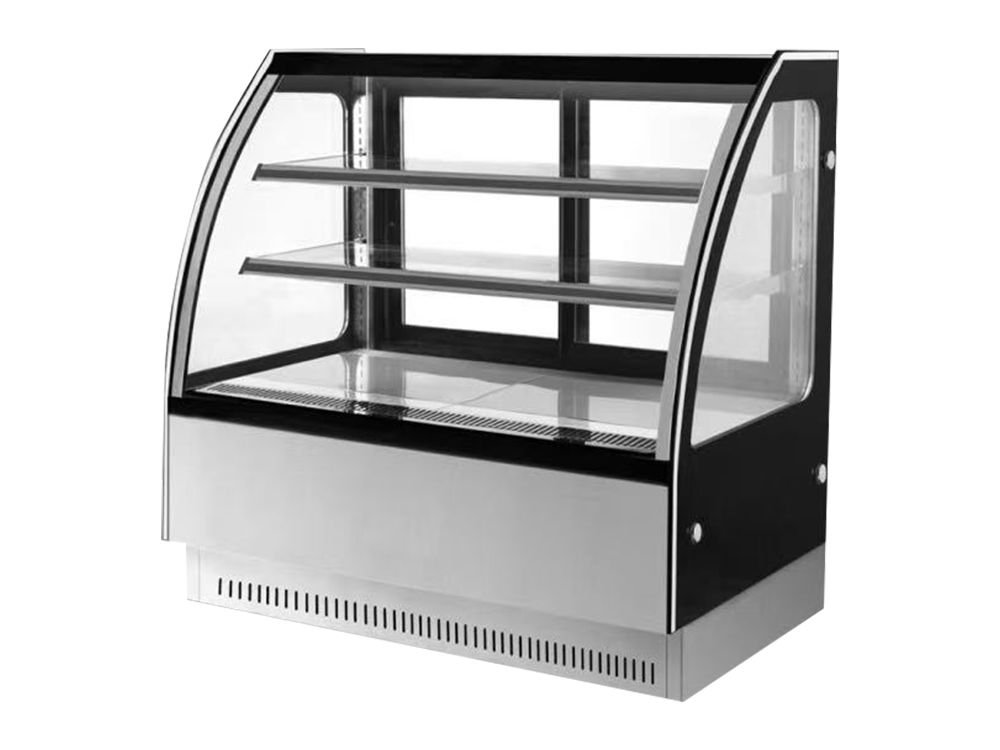 Refrigerated Display Cases and Fan-Cooled Cake ShowcasesCompare refrigerated display case options for cake showcases, with DG-900 and DG-1200 fan-cooled models for commercial display refrigeration.View Product →
Glass door merchandiser
- Tightest band control, because the closed door protects the load in a warm aisle.
- Lowest energy per litre of the three formats, unless heated anti-condensation glass is specified.
- Every shopper interaction adds a door opening, so recovery time matters.
- Best fit for dairy, craft beer, wine and premium packaged goods.
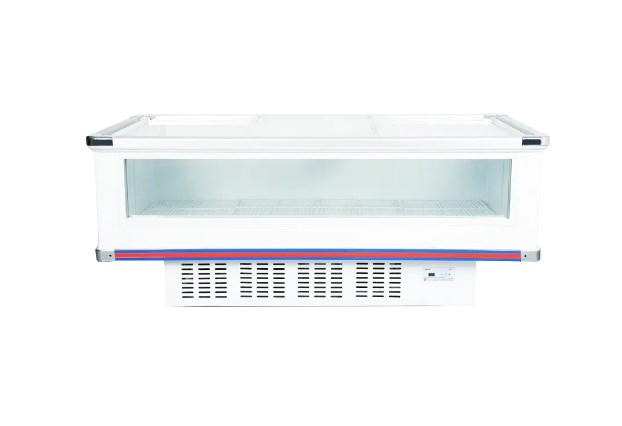
Open air multi-deck
- Fastest restocking and the strongest impulse pickup in a heavy footfall aisle.
- Two to three times the daily energy draw of a glass door cabinet of similar length.
- Needs a stable store ambient; above 25 degrees C the load temperature climbs.
- Best fit for grab-and-go drinks, sandwiches and chilled ready meals.
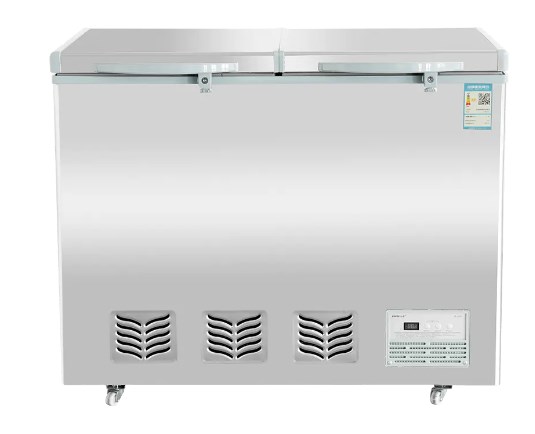
Chest display cabinets sit at the other end of the trade-off. They hold temperature with the least energy and lose almost nothing when opened, but shoppers have to reach down and cannot see the full range at a glance. Use them for bulk frozen or bulk chilled volume where impulse sales are not the objective.
Sizing a Commercial Display Cooler: Gross Volume Against Real Load
Plan on 55 to 65 percent of the stated gross volume being usable for saleable product. The remainder disappears into the evaporator housing, the space behind the rear duct, the shelf pitch and the door thickness.
Shelf pitch is the number that decides how much of that usable volume you actually get. Bottles and cans need 250 to 300 mm of clearance. Cakes and trays need 380 to 450 mm. A cabinet tuned for tall cake trays will carry far fewer drinks per shelf than the same cabinet tuned for cans, even though the outer dimensions are identical. Always price a display cooler per sellable unit, not per litre.
A 1.5 m glass door cabinet advertised at 1,200 L typically swallows around 700 L of stacked 500 mL bottles once shelf clearance and the rear evaporator housing are accounted for.
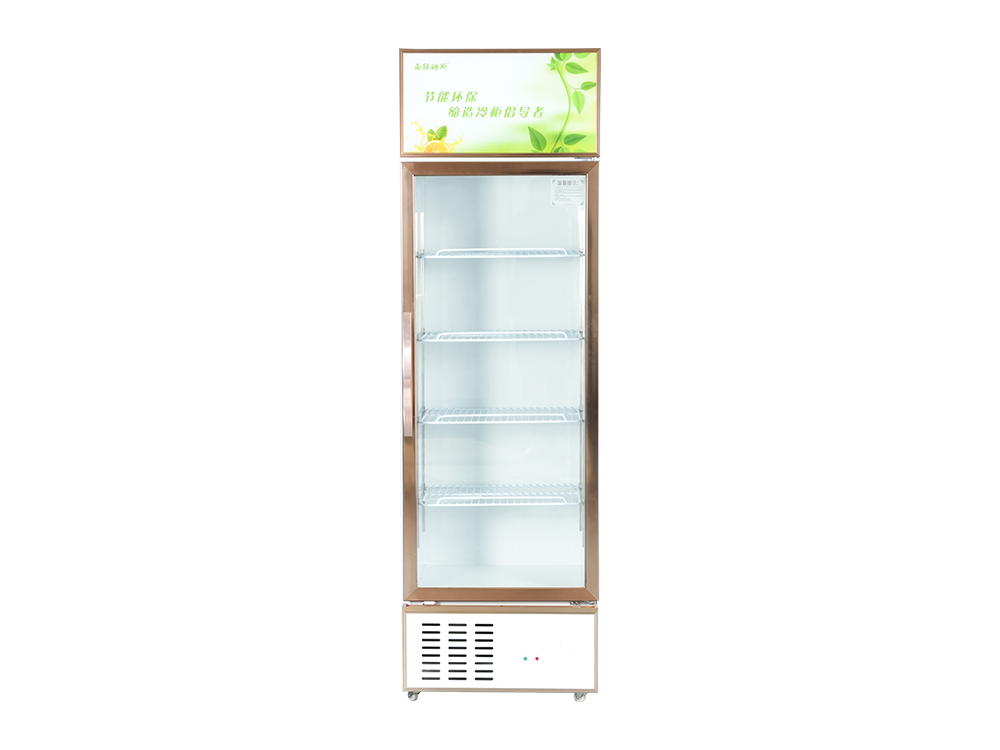 Custom Beverage Display Coolers for Retail and Food ServiceBrowse beverage display coolers including single-door, open-door, freezer, and wine models, and compare shelf configurations for retail or food-service spaces.View Product →
For beverage programmes, check the number of shelf positions and whether they are adjustable in fixed steps. A cabinet with five adjustable positions fits more product mixes across a year than a fixed four-shelf design, and it costs no more at the point of purchase.
Energy and Running Costs the Spec Sheet Does Not Show
A commercial display cooler draws roughly 2 to 7 kWh per day depending on format, and the door or front configuration usually matters more than the compressor brand. The chart below shows typical 24-hour consumption for four cabinet formats of comparable footprint in a 25 degree C store.
Daily energy use by cabinet format, 1.2 to 1.5 m cabinets at 25 C ambient
2-3% extra compressor run time for every 1 degree C the store ambient sits above the cabinet's rated climate class. A 30 degree C back-of-house can add a fifth to the annual electricity bill of an open air cabinet.
Two cost drivers are routinely missed. Heated anti-condensation glass, fitted to stop sweating in humid stores, adds 15 to 25 percent to cabinet consumption, so specify it only where the store humidity genuinely demands it. Night blinds on open air cabinets reduce overnight consumption sharply for a very small capital outlay, and they pay back inside the first year in most convenience stores.
Installation and Maintenance Rules That Protect the Rating
Give the condenser at least 100 mm of rear clearance and 150 mm at the sides, keep the cabinet out of direct sunlight and away from fryers, and clean the condenser coil every eight to twelve weeks. Cabinets that fail their temperature band in service almost always fail one of those three rules rather than a mechanical part.
The installation checks that prevent most in-service complaints
- Measure the ambient at the cabinet's intake after the store has been trading for two hours, not at commissioning.
- Confirm the cabinet sits on its own circuit and is not sharing a spur with grills or fryers.
- Level the cabinet so the door gasket seals evenly along its full length.
- Leave the cabinet to stabilise for 24 hours before loading it with stock.
- Record the product temperature at the warmest shelf position, then repeat the check monthly.
Gaskets are the cheapest failure point and the most expensive to ignore. A torn gasket lets warm, humid air into a glass door cabinet all day, which loads the evaporator with frost and forces longer defrost cycles. Replacing a gasket takes minutes; replacing a compressor does not.
Build Quality and Certification Checks Before Ordering
Check four things in this order: evaporator coating, door gasket material, glass specification and the certification file. Those four decide how the cabinet behaves in year three, when the warranty has ended and the coil has been exposed to humid air for a thousand days.
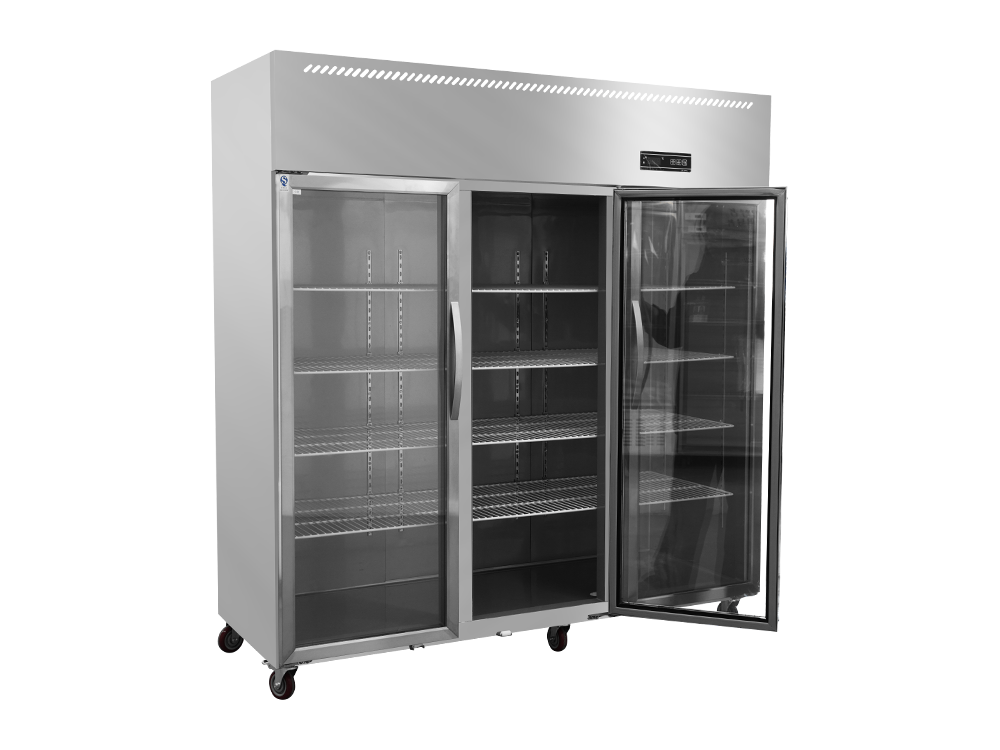 GB-1380F Large Three-Door Glass Door Chiller FreezerLarge-capacity commercial chiller/freezer with glass door and fan cooling, sized 1800*730*1950 mm; review glass and cooling details before specifying.View Product →
304 stainless steel for wet, salty or coastal kitchen environments
2-3 kW typical condensing capacity swing you should ask to have documented
CCC / CE certification files worth requesting before a purchase order
Spray-coated steel is a sound choice for dry retail floors and is easier to keep clean in food service, but it will not survive a wet, salty environment the way a stainless body does. Ask what the evaporator coil is coated with, whether the glass carries an anti-fog film, and how the manufacturer tests gasket life. A supplier that documents those answers is a supplier you can hold to a specification. Our own factory and production lines are documented publicly for exactly that reason: buyers can verify the sampling and inspection equipment before a container ships.
Frequently Asked Questions
What temperature should a commercial display cooler run at?
Fresh food and beverage display coolers run between 2 and 8 degrees C, measured as the warmest package temperature rather than the controller reading. Dairy and fresh meat belong at the tight end, 2 to 4 degrees C. Wine and spirits sit higher, between 8 and 14 degrees C. Frozen display cabinets hold minus 18 degrees C or lower.
How much clearance does a commercial display cooler need?
Leave at least 100 mm behind the cabinet and 150 mm at the sides so the condenser can reject heat. Anything less raises head pressure, shortens compressor life and pushes the cabinet above its temperature band in warm weather. Rear clearance matters most in back-of-house installations where the ambient already runs warm.
Is an open air display cooler more expensive to run than a glass door model?
Yes, substantially. A 1.2 to 1.5 m open air multi-deck typically draws around 6.4 kWh per day against roughly 3.6 kWh for a glass door merchandiser of similar length, before any ambient penalty is applied. Night blinds and a controlled store ambient are the two fastest ways to close the gap.
How much saleable product fits in a display cooler per litre of gross volume?
Expect 55 to 65 percent of gross volume to be usable. Shelf pitch of 250 to 300 mm suits cans and bottles, while trays and cakes need 380 to 450 mm. Compare cabinets by sellable units per square metre of floor space rather than by advertised litres.
Related News

Looking for Reliable Partner?
We are committed to becoming your most trusted partner.
Contact info.
 +86-153 0659 4509
 +86-(0)573-8796 5558
 zjxingbao@gmail.com
 No. 10 Baisha Road, Lianhang Development Zone, Chang'an Town, Haining City, Zhejiang China 314423
Mobile QR Code
Copyright © Zhejiang Xingbao Electrical Appliance Co., Ltd. All Rights Reserved. Custom Commercial Refrigerator Factory
