

 en
en  English
 中文简体
中文简体 Español
 عربى
عربىCommercial Seafood Display Case Buying Guide: Specs, Temperature, and Costs
 2026.09.30
 Industry News
A fish retailer in Shanghai monitored daily shrink reports for 14 straight days and found that 9 percent of the fresh catch was being discarded, most of it from product sitting in the temperature danger zone inside open display cabinets. This failure pattern repeats across seafood departments everywhere, and the cause is rarely the supplier; it is the commercial seafood display case drifting several degrees above specification during busy hours. Fresh fish, shellfish, and crustaceans are among the most temperature-sensitive items a store can carry, and the cabinet you choose determines whether those items sell at near-full margin or turn into recurring weekly loss.
A Commercial Seafood Display Case Must Hold 0-2C for Fresh and -18C for Frozen
A commercial seafood display case must maintain 0-2°C for fresh product and -18°C or below for frozen product, with no sustained drift beyond 1°C from the set point. Seafood muscle has high water activity, and spoilage enzymes stay active above 2°C, so bacterial growth accelerates the moment the product leaves the safe band.
The relationship between temperature and shelf life is steep, not linear. For every 1°C rise above 2°C, fresh fish loses roughly 15-25 percent of its remaining display life. At 7°C, a fillet that would hold for two days under correct refrigeration can spoil in less than half that time. Temperature uniformity matters as much as the target number: a case with warm spots near the top deck is where spoilage starts before customers even reach the product. Retailers comparing equipment should ask manufacturers for published temperature-holding curves and check where the probe was placed during testing. A fuller breakdown of display cooler temperature zones is available in our buying guide on the subject.
Choosing the Right Commercial Seafood Display Case Format for Your Floor Plan
Choose a chest-style glass-lid case for high-volume frozen seafood, a glass-door upright for self-service retail packs, and an open-top fresh case for ice-bed presentation. There is no universal seafood cabinet; the correct format depends on what you sell, how customers access it, and how much floor space the case can occupy without blocking aisles.
| Cabinet type | Best application | Operating range | Typical footprint |
| Chest, curved glass | Whole fish, bulk frozen packs | -18 to -22°C | Wide, low profile |
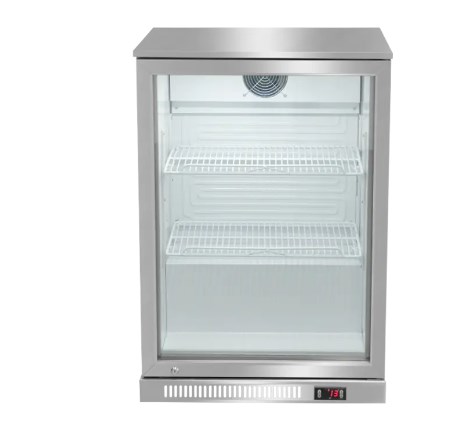
| Glass-door upright | Retail self-service packs | -18 to -22°C | Narrow, tall |
| Open-top fresh case | Ice-bed fresh seafood display | 0 to 4°C | Wide, open access |
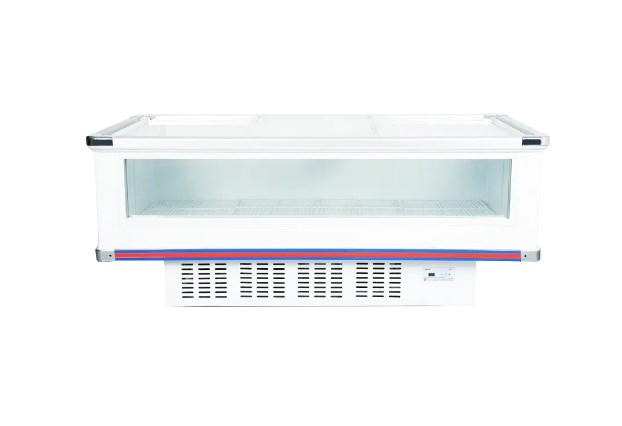
| Island freezer | Supermarket center-floor frozen display | -22 to -18°C | Long, walkaround |
Wet fish on ice beds should never share a case with frozen packs; ice melt raises humidity and forces the compressor to work harder.
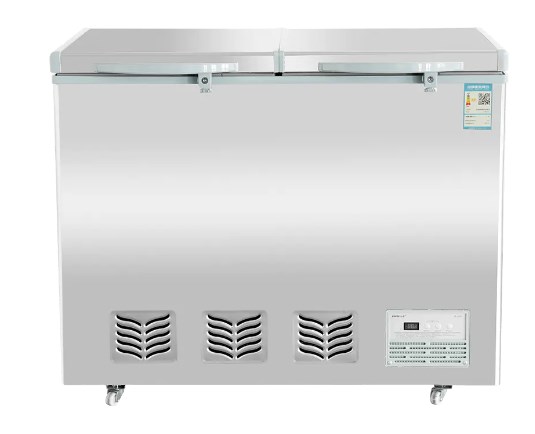
Stores that want a factory-matched seafood cabinet typically start with the commercial kitchen freezer series. Zhejiang Xingbao Electrical Appliance Co., Ltd., a manufacturer with two industrial bases and an annual capacity of 300,000 refrigeration units, builds the luxury new white freezer seafood cabinet for full-size retail display and the new desktop freezer seafood cabinet for deli counters and compact storefront operations. Both run on the same air-cooled system platform, so spare parts and service experience stay consistent across the store.
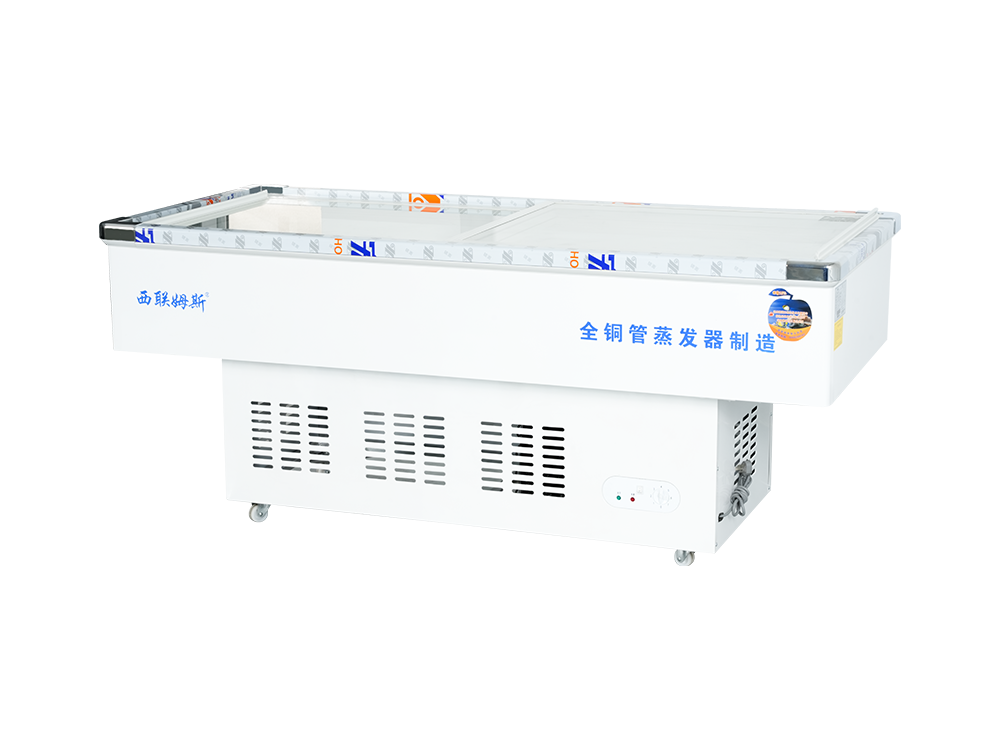 Luxury White Freezer Seafood Display Cabinet for RetailThis full-size seafood cabinet pairs a white high-end finish with rapid air-cooled refrigeration and smart temperature control. It suits retail displays needing consistent cold and ample storage.View Product →
 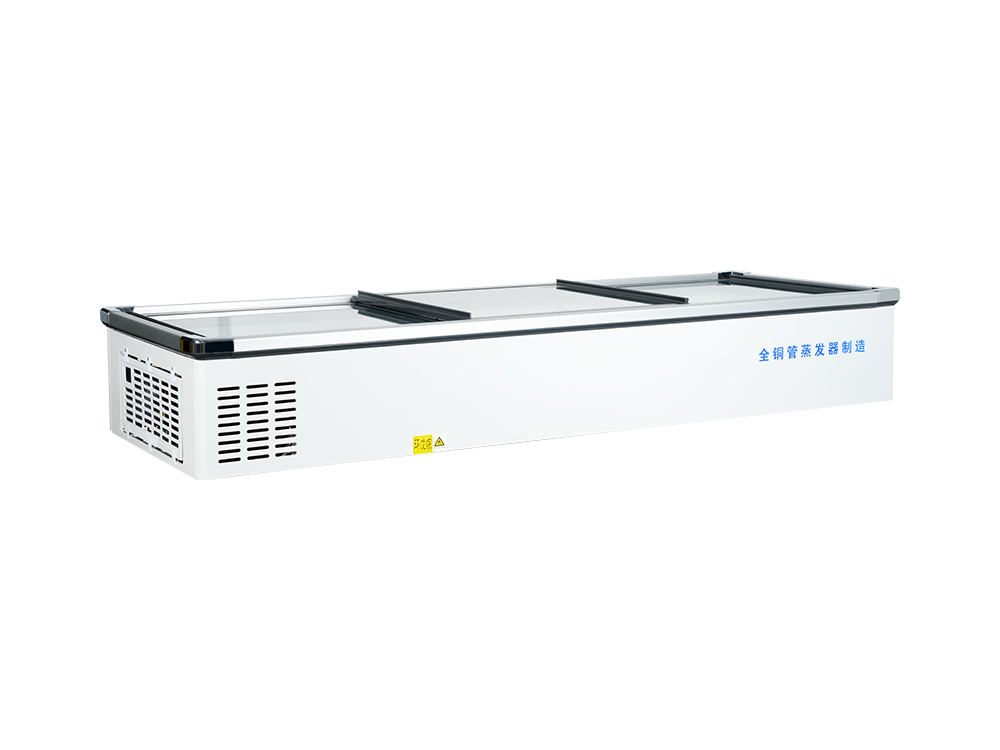 Compact Desktop Freezer Seafood Showcase for Deli CountersA space-saving desktop unit designed for deli counters and compact storefronts. It offers quick cooling, adjustable temperature, and easy-to-clean interiors for efficient daily seafood display.View Product →
Cooling System and Defrost Control Temperature Uniformity in Seafood Display Cases
Fan-forced air circulation with automatic defrost holds case temperature far more consistently than static coil cooling. Static systems let temperature stratify inside the cabinet, with the bottom running 3-5°C colder than the top, and that vertical spread creates the warm pockets where fresh seafood deteriorates first.
Static coil cooling
- 3-5°C temperature spread inside one cabinet
- Frost builds unevenly on the evaporator coil
- Lower upfront price for the same external size
- Higher spoilage risk for open seafood displays
- Acceptable only for stable, closed-door storage
Fan-forced air cooling
- Holds within 1°C across the display area
- Automatic defrost keeps the coil clear and efficient
- Higher upfront cost, lower product loss rate
- Required for fresh fish presented on ice beds
- Better humidity control with off-cycle defrost
Defrost discipline is as important as the compressor. A 3 mm layer of frost on the evaporator cuts cooling capacity by 10-15 percent because it insulates the coil and restricts airflow. Automatic defrost cycles, typically four to eight per day depending on how often the lid or door opens, keep the case operating near design capacity. In humid seafood sections, off-cycle defrost with collection pans is preferable to electric defrost heaters because it adds less heat back into the cabinet.
Temperature uniformity: the maximum temperature difference across the display area during one full compressor cycle. Below 1.5°C is the practical benchmark for commercial seafood display cases.
Glass specification also changes performance. Single-pane glass increases condensation and radiant heat load; double-glazed low-E glass reduces both and lowers the stress on the refrigeration system. Heated glass frames prevent fogging but draw additional watts, so buyers should weigh frame heaters against the store's ambient humidity and electricity tariff.
Energy Use Is Where a Commercial Seafood Display Case Costs the Most
A two-metre commercial seafood display case draws 8-15 kWh per day depending on load, glass specification, and ambient room temperature. At commercial electricity rates, that amounts to $1,000-1,800 per year, and over a three-year ownership period the power bill can exceed the invoice price of the cabinet itself.
8-15 kWh
Daily draw for a two-metre seafood display case in normal retail ambient conditions.
30%
Typical energy saving when the cabinet meets the European A+ efficiency standard.
10-15%
Cooling capacity lost when 3 mm of frost builds up on the evaporator coil.
The largest controllable levers are the condensing unit, insulation thickness, and night covers. A cabinet with at least 60 mm of high-density polyurethane insulation holds temperature longer through defrost and overnight shutdown. Night blinds or fully glass-door models reduce cold air spill into the aisle. Open-top fresh cases lift impulse sales but consume an estimated 25-40 percent more energy than glass-door equivalents of the same display area, so hybrid layouts that keep a small open bed for hero items and glass doors for the rest of the range usually deliver the best balance.
Buyers should ask for annual energy consumption figures in kWh per 24 hours at 25°C ambient, measured with real product load rather than an empty-cabinet test.
Size and Placement: Merchandising Volume First, Storage Second
Size a seafood display case from the volume you need to merchandise each morning, never from the total stock you want to store. Overloading blocks airflow between packs, creates warm pockets, and accelerates the spoilage pattern that costs seafood retailers 5-10 percent of revenue every year.
A 1.5-2.0 metre case typically displays 60-120 kg of whole fish packed on ice, or 80-150 retail packs in a glass-door frozen configuration. Walk the sales floor before you write the specification: count the SKUs customers actually see, then match case length and shelf depth to that number. Leave at least one metre of clearance around the case for air return and daily cleaning; cabinets pushed against walls or into corners run hotter and consume more energy.
For prepared seafood, portion packs, or grab-and-go items at reach-in height, the open-door lower-unit freezer display cabinet is a compact alternative that keeps product visible without occupying the top deck of a full-height merchandiser. It suits supermarkets, convenience stores, and catering counters where floor space is tight.
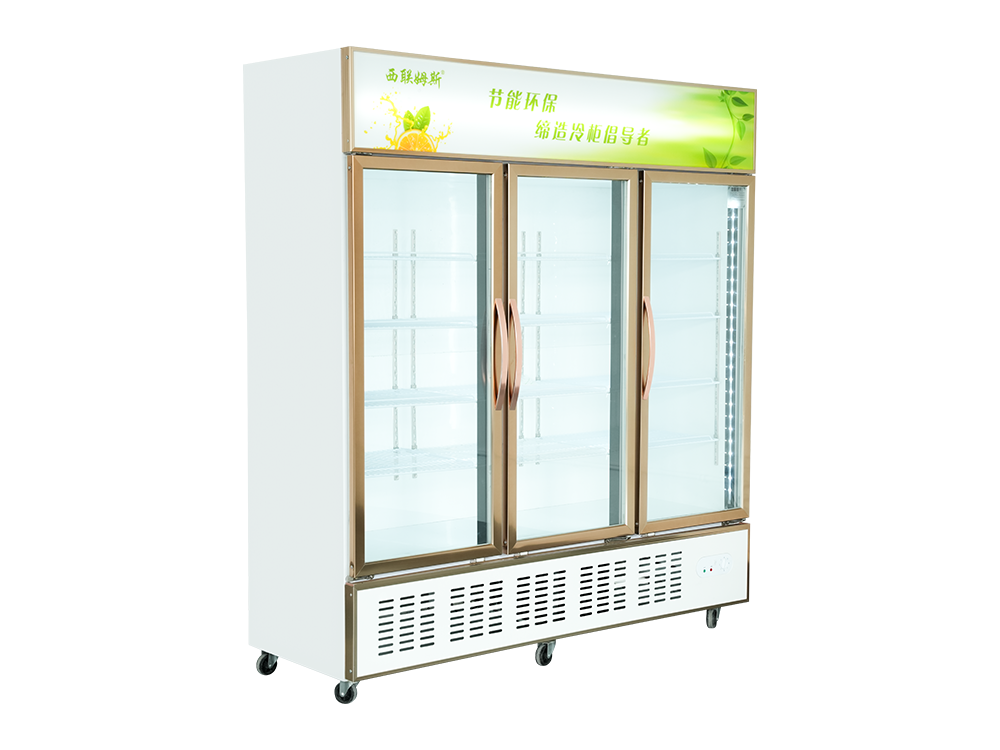 Lower-Unit Open-Door Freezer Display ShowcaseA reach-in freezer display with open-door access, ideal for grab-and-go prepared seafood in tight spaces. Available in multiple sizes with air-cooled circulation and anti-condensation features.View Product →
Placement matters as much as sizing. Keep the case at least two metres from entrance doors, out of direct sunlight, and away from air-conditioning supply vents. Every heat source close to the cabinet adds load to the refrigeration system, extends compressor run time, and narrows the margin between safe storage and spoilage.
Heat sources within two metres of the cabinet can raise compressor run time by 8-12 percent; position the case away from doors, sunlight, and air vents.
Before you settle on a commercial seafood display case, request the full specification sheet from the factory, ask how the temperature-holding test was conducted, and compare energy figures under identical ambient conditions.
Common Seafood Display Case Questions
What temperature should a commercial seafood display case hold for fresh fish?
Hold fresh fish and shellfish at 0-2°C. Sustained temperatures above 2°C produce measurable shelf-life loss, and anything above 4°C invites rapid bacterial growth and health-inspection failures.
Can one cabinet display both fresh and frozen seafood?
Dual-temperature display cases exist, but fresh and frozen lines need different cold-air strategies. Most retailers get better temperature control and lower energy cost by separating fresh open-top cases from frozen glass-door or chest units.
How often should a seafood display case defrost?
Most air-cooled systems run a defrost cycle every four to six hours. High-humidity seafood sections may need more frequent cycles; if frost beyond 3 mm accumulates on the coil, increase defrost frequency and check the door seal.
Are glass-door seafood display cases more energy efficient than open cases?
Yes. Glass-door models typically use 25-40 percent less energy than open cases of the same display area, at the cost of some impulse sales. A hybrid layout that uses a small open bed for hero items and glass doors for the rest of the range balances energy use with merchandising impact.
Related News

Looking for Reliable Partner?
We are committed to becoming your most trusted partner.
Contact info.
 +86-153 0659 4509
 +86-(0)573-8796 5558
 zjxingbao@gmail.com
 No. 10 Baisha Road, Lianhang Development Zone, Chang'an Town, Haining City, Zhejiang China 314423
Mobile QR Code
Copyright © Zhejiang Xingbao Electrical Appliance Co., Ltd. All Rights Reserved. Custom Commercial Refrigerator Factory
