

 en
en  English
 中文简体
中文简体 Español
 عربى
عربىFan-Cooled Undercounter Refrigerator: Cooling, Sizing, Installation and Buying Guide
 2026.08.28
 Industry News
In a commercial kitchen, every inch below the worktop competes with storage, prep equipment and service access. A fan-cooled undercounter refrigerator addresses that problem by combining refrigerated storage with forced-air circulation in a compact cabinet that can sit below—or become part of—a working counter.
Unlike static cooling, fan cooling uses an evaporator fan to circulate chilled air throughout the cabinet. This can improve temperature recovery after door openings and reduce shelf-to-shelf temperature differences during busy service periods.
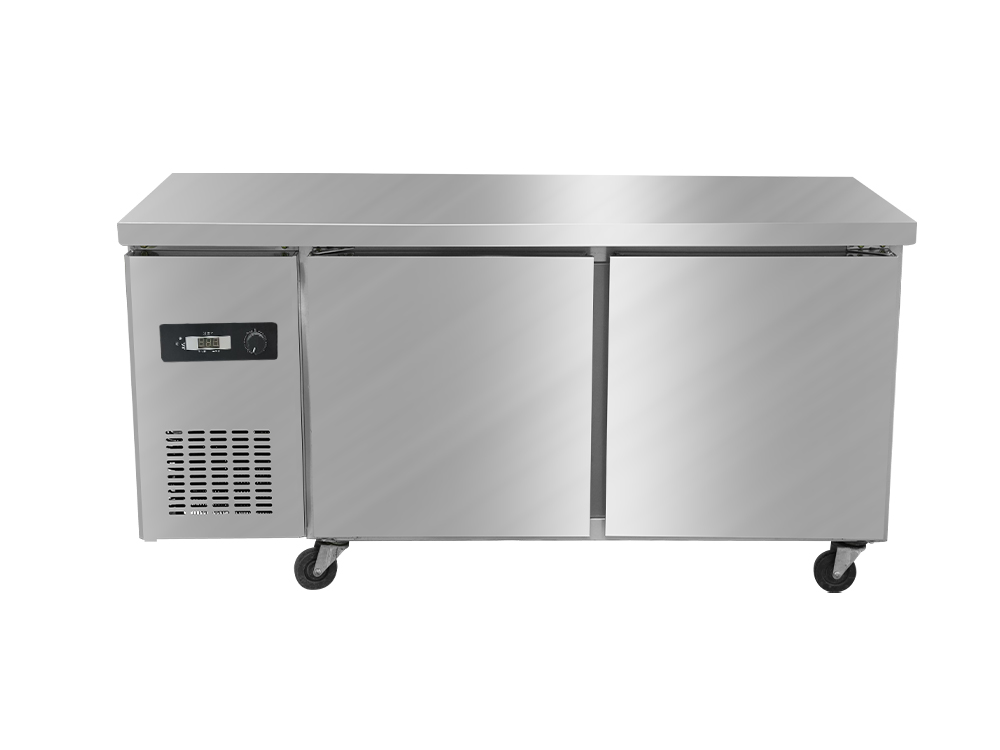
Zhejiang Xingbao Electrical Appliance Co., Ltd. manufactures commercial refrigeration equipment including fan-cooled undercounter units. Its SLLDZ4-480F, for example, is listed at 1800 × 800 × 800 mm and is designed as a refrigerated/frozen air-cooled workbench.
How Fan Cooling Works in an Undercounter Refrigerator
Fan cooling is also commonly described as forced-air refrigeration. The refrigeration circuit removes heat through the evaporator, while one or more fans move the cooled air through the storage compartment. The air returns to the evaporator and is cooled again, creating continuous circulation.
This is the main difference from a static-cooling cabinet. In a static system, cold air falls and warmer air rises naturally. That approach can work well when doors remain closed for long periods, but larger temperature differences may develop between different areas of the cabinet.
A forced-air cabinet is more useful when staff open doors repeatedly. Every opening introduces warm kitchen air. The fan helps redistribute chilled air after the door closes, supporting faster recovery and more even storage conditions.
However, airflow also has a tradeoff. Strong circulation may dry uncovered produce, desserts, herbs or prepared ingredients. Moisture-sensitive foods should therefore be stored in covered pans or sealed containers.
Do not judge a cabinet only by an advertised fan CFM figure. Actual airflow also depends on evaporator resistance, duct design and product placement. Ask how the complete cabinet is tested under realistic loads.
Fan Cooling vs. Static Cooling: Which Is Better?
| Factor | Fan-Cooled / Forced-Air | Static Cooling |
| Air movement | Active circulation | Natural convection |
| Temperature distribution | Generally more even | May vary more by shelf position |
| Door-opening recovery | Usually faster | Usually slower |
| Best use | Busy kitchens and frequent access | Lower-frequency storage |
| Food moisture | Uncovered food may dry faster | Gentler air movement |
| Maintenance | Fans add service components | Simpler air-distribution system |
Forced-air cooling often suits high-turnover prep lines, bars and hotel kitchens, while static cooling may fit lower-traffic storage or products that benefit from gentler airflow.
Sizing, Capacity and Real-World Energy Consumption
Undercounter refrigeration should be sized around usable storage, not only exterior width. Start with the pans, trays, bottles or containers needed during the busiest shift. Then make sure they fit without blocking internal air passages. A cabinet packed tightly around the evaporator or return-air vents may have good nominal capacity but poor practical airflow.
Door-opening frequency is equally important. A unit opened every few minutes faces a larger heat load, while warm products create additional refrigeration demand.
For energy comparisons, use rated daily or annual consumption for the exact model whenever available. Do not assume every fan-cooled unit automatically uses more energy than every static model. Compressor efficiency, insulation, refrigerant, door construction, defrost control and ambient temperature can have a greater impact.
Annual energy use = rated kWh/day × 365
Annual electricity cost = annual kWh × local electricity rate
For example, a unit rated at 1.5 kWh/day would use about 547.5 kWh per year. At a hypothetical electricity rate of $0.15/kWh, annual electricity cost would be about $82.13. For a better purchasing comparison, combine acquisition price, five-year energy cost and expected maintenance instead of comparing purchase price alone.
Undercounter Dimensions, Ventilation and Installation Requirements
Commercial undercounter equipment should not be selected from residential cabinet dimensions. Restaurant worktops and refrigerated workbenches may be deeper, wider and built around stainless-steel preparation surfaces, casters or adjustable feet.
Xingbao lists the SLLDZ4-480F at 1800 × 800 × 800 mm, approximately 70.9 × 31.5 × 31.5 inches. That makes site measurement essential before ordering.
Measure the available width, finished counter height, usable depth, door swing and route into the kitchen. Confirm whether casters or feet are included in the stated height. Then identify where the condenser takes in and exhausts air.
Front-ventilated designs are generally easier to integrate into tight recesses. Rear- or side-ventilated units require adequate clearance around their intake and exhaust areas. Do not apply one generic clearance number to every model; follow the selected unit's installation specification.
Condensate management also matters. Some units use an internal evaporation tray, while others may require a drain arrangement. Confirm the solution before installation, especially in humid kitchens or freezer applications. Electrical checks should include voltage, frequency, plug type, circuit capacity and grounding, while leaving enough access for future condenser, fan and controller service.
Noise, Maintenance and Common Cooling Problems
Fan-cooled refrigerators can generate noise from the evaporator fan, condenser fan, compressor and cabinet panels. A single dB value can be misleading unless test conditions and measurement distance are stated.
Routine maintenance helps control both noise and energy use. Inspect condenser coils before grease and dust restrict airflow, clean fan blades and guards, keep internal vents open, check door gaskets and make sure drains remain clear.
If cabinet temperature begins to rise, first check the condenser, door seals and blocked internal airflow. Weak air movement may indicate an evaporator-fan problem or abnormal icing. Rattling may come from a loose guard, bracket or worn fan bearing.
For B2B buyers, parts availability should be evaluated before purchase. Ask whether fan motors, temperature controllers, sensors, gaskets and other common service parts can be supplied by model number. Easy access to replaceable components can be more valuable over time than a slightly lower initial equipment price.
How to Choose a Fan-Cooled Undercounter for Tight Spaces
A compact kitchen does not necessarily need the smallest refrigerator. It needs the cabinet that makes the best use of available space while maintaining airflow and service access.
| Application | Useful Configuration |
| Narrow kitchen | Shallow cabinet with efficient interior layout |
| Built-in position | Front ventilation where appropriate |
| Busy prep line | Forced-air cooling with good recovery performance |
| Prep workstation | Durable stainless-steel worktop |
| Limited service access | Accessible condenser, controller and fan assembly |
| OEM project | Custom dimensions, door layout or branding options |
Also consider doors versus drawers: doors provide flexible storage, while drawers can improve access to frequently used pans.
Certifications and Commercial Buyer Checklist
Certification requirements vary by country, application and local authority. In the United States, NSF/ANSI 7 establishes sanitation and performance requirements for commercial refrigerators and freezers, including undercounter equipment. Buyers should verify the certification status of the exact model required for their project rather than assuming that a company-level certificate applies to every product.
Xingbao states that it has obtained CCC, CE and CFCC certifications. For a U.S. project, buyers should separately confirm the sanitation, electrical and other approvals required by the local jurisdiction.
Before placing an order, request the specification sheet, working temperature range, refrigerant information, electrical requirements, energy data if available, ventilation direction, warranty terms and replacement-parts list. For OEM/ODM orders, also confirm dimensional customization, door configuration, branding, packaging and project quantity.
Talk to Xingbao About Your Undercounter Refrigeration Project
Zhejiang Xingbao Electrical Appliance Co., Ltd. integrates refrigeration product design, R&D, manufacturing and marketing, with products including commercial kitchen refrigerators, freezers, display cabinets and related refrigeration equipment.
When selecting a fan-cooling undercounter refrigerator, do not choose by exterior dimensions alone. Match the equipment to your storage load, door-opening frequency, target temperature, ventilation conditions, available service space and destination-market requirements.
Send Xingbao your required dimensions, application, target temperature and installation layout to discuss a suitable configuration, request technical specifications, or evaluate an OEM/ODM project.
FAQ
What is fan cooling in an undercounter refrigerator?
Fan cooling uses an evaporator fan to circulate chilled air through the cabinet. Compared with static cooling, it generally improves air distribution and recovery after door openings.
How should I size a fan-cooled undercounter unit?
Start with the real storage load, then consider usable interior space, shelf or pan layout, door-opening frequency, ventilation and installation dimensions. Avoid sizing by external width alone.
Does fan cooling always use more electricity than static cooling?
No. Total energy use also depends on compressor efficiency, insulation, door design, ambient conditions, defrost control and the overall refrigeration system.
How much ventilation clearance is required?
Clearance depends on condenser layout and manufacturer requirements. Front-ventilated units may suit tighter installations, while rear- or side-ventilated units need sufficient intake and exhaust space.
How noisy is a fan-cooled undercounter refrigerator?
Noise depends on the compressor, fan design, cabinet structure and installation environment. Compare manufacturer test data only when measurement conditions are clearly stated.
What maintenance does a fan-cooled unit require?
Regularly inspect and clean the condenser, fans, vents, door gaskets and drains. Investigate unusual noise, weak airflow, icing or slow temperature recovery before the problem becomes more serious.
Which certifications should U.S. commercial buyers check?
NSF/ANSI 7 is an important standard for commercial refrigeration sanitation and performance. Buyers should also verify electrical and other requirements for the exact installation and local jurisdiction.
Related News

Looking for Reliable Partner?
We are committed to becoming your most trusted partner.
Contact info.
 +86-153 0659 4509
 +86-(0)573-8796 5558
 zjxingbao@gmail.com
 No. 10 Baisha Road, Lianhang Development Zone, Chang'an Town, Haining City, Zhejiang China 314423
Mobile QR Code
Copyright © Zhejiang Xingbao Electrical Appliance Co., Ltd. All Rights Reserved. Custom Commercial Refrigerator Factory
