

 en
 English
 中文简体
 Español
 عربى
Commercial Beverage Refrigerator Guide: Specs, Recovery Time and Buying Checklist
 2026.11.11
 Industry News
A two-door glass front beverage cooler that holds 38°F in a 70°F showroom can climb past 50°F on its first 95°F afternoon with a busy service bar in front of it. That gap between showroom performance and real service conditions is the most common reason beverage coolers fail inspections, spoil stock, or get replaced inside three years, and it is why a commercial beverage refrigerator is built to a different standard than a household drinks fridge.
Buyers who treat a beverage cooler as a box with a compressor and a plug usually pay for it twice: once at purchase, and again eighteen months later when the cabinet can no longer recover between shifts. This guide covers the specifications that actually predict performance, the numbers worth writing into a purchase order, and the checks that keep an import order from arriving with the wrong cabinet.
38°F Product temperature a commercial beverage refrigerator is expected to hold while ambient air reaches 90°F or higher and the doors keep opening.
Commercial Beverage Refrigerator Basics: Ratings, Certification and Duty Cycle
A commercial beverage refrigerator is a self-contained cabinet designed to hold product between 33°F and 40°F at ambient temperatures of 90°F and above, built with a forced-air evaporator, a commercial-duty compressor, and parts a technician can replace on site. In the United States the category is also defined by NSF/ANSI 7 for sanitation and by a Department of Energy test procedure that reports energy use at a fixed ambient condition.
A drinks fridge rated at 75°F ambient is not a smaller version of a commercial unit. It is a different machine with a different duty cycle, a different test standard and a different warranty.
Residential cabinets are rated for living-room conditions. Move one behind a bar and three things happen at once: the compressor never shuts off, the static evaporator frosts over, and cabinet temperature drifts 8°F to 12°F above the set point during the busiest two hours of the night. The table below shows where the two designs separate.
| Specification | Residential drinks fridge | Commercial beverage refrigerator |
| Rated ambient | 70°F to 80°F room | 90°F to 100°F bar, kitchen or shop floor |
| Product temperature under load | 38°F to 45°F, drifts when loaded | 33°F to 40°F held under load |
| Evaporator | Static cold wall, gravity air | Forced-air fan coil |
| Compressor duty | Light duty, intermittent | Commercial duty, continuous |
| Door glazing | Single pane, no frame heat | Double pane, low-E, heated frame |
| Certification | Household safety marks only | NSF/ANSI 7, CE or CCC as applicable |
| Typical service life | 3 to 6 years | 8 to 12 years with serviceable parts |
| Warranty in a commercial setting | Commonly void | Written for commercial operation |
Temperature Recovery: The Commercial Beverage Refrigerator Spec Buyers Skip
Ask for recovery time, not just the set point. A beverage refrigerator that returns to 38°F within fifteen minutes of a full door opening protects stock through a dinner rush; a unit that needs thirty minutes or more spends most of the evening above target even though the thermostat never moves.
Minutes to return to 38°F after a 60-second door opening
Representative field observations at 90°F ambient with a fully loaded cabinet. Treat the pattern as directional rather than as a certified test result.
Three variables drive that number. Evaporator type decides how fast cold air reaches the whole cabinet: a fan coil circulates air through the load in minutes, while a static plate has to conduct cold through contact. Door construction decides how much warm air enters: double-pane low-E glass with a heated frame loses far less than a single pane. Ambient temperature decides the size of the deficit the compressor has to close, which is why a cabinet rated at 90°F behaves differently from one rated at 75°F.
Put recovery in the purchase order as a number. Suppliers who publish it are testing cabinets under load; suppliers who only publish a thermostat range are quoting a brochure.
Matching Door Configuration and Capacity to How Drinks Are Sold
Choose the cabinet from the service model backward: solid-door back bar coolers for speed and energy efficiency, glass-door merchandisers for self-service sales, and undercounter units where counter space is the constraint. Door type costs either labour time or sales, so it is the first decision, not the last.
Solid-door back bar cooler
- Fastest recovery, because cold air stays inside when the door shuts.
- Lower energy draw, since no glass surface has to be kept clear of condensation.
- Best fit for high-volume speed service where the guest never sees the cabinet.
Glass-door merchandiser
- Sells without staff, because product stays visible from the aisle or the bar.
- Double-pane low-E glass with frame heating controls condensation in humid rooms.
- Needs a larger refrigeration system to offset heat gain through the glass.
Capacity usually settles the door count. A two-door back bar cooler holds roughly 400 to 500 twelve-ounce cans. A three-door glass merchandiser of similar width holds 600 or more mixed bottles, at the cost of slower recovery and a higher energy draw.
Where the service lane is narrow, sliding-door formats such as stainless steel back bar coolers keep the aisle clear and reduce gasket damage from foot traffic. Stainless exteriors also survive the daily wipe-down that painted steel loses to within two or three years in a working bar.
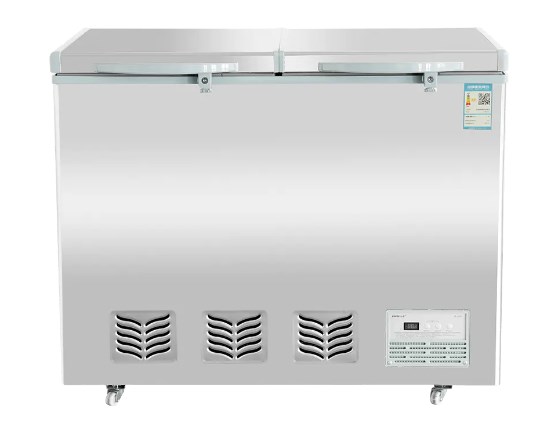
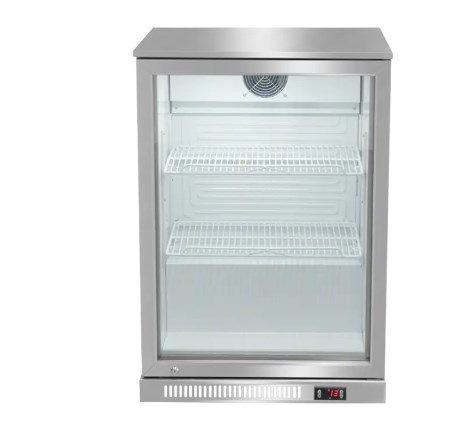
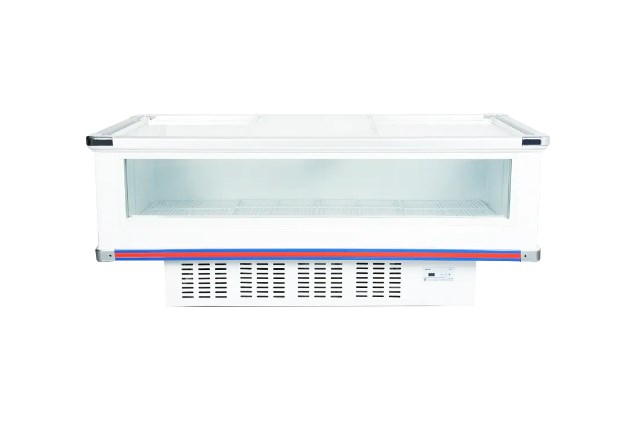
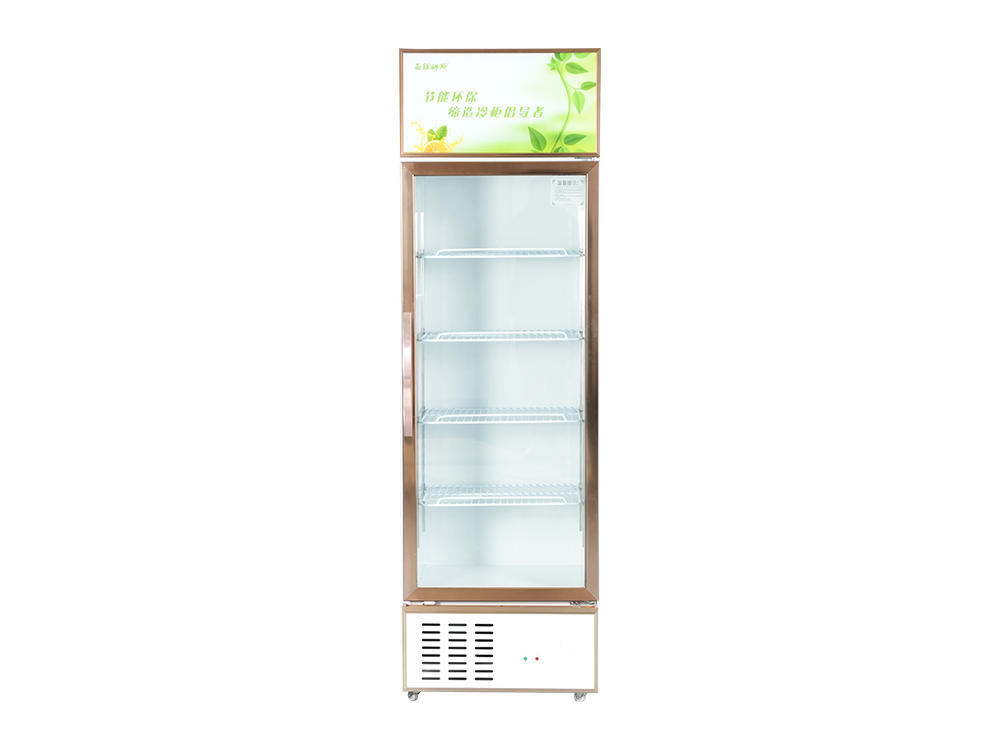 Commercial Beverage Display Coolers and Freezer ShowcasesBrowse beverage display coolers and freezer showcases for commercial beverage storage, with single-door, open-door, and wine cabinet options in varied capacities and dimensions.View Product →
Energy, Refrigerant and Five-Year Cost of Ownership
Refrigerant and door type move five-year cost far more than the purchase price does. A cabinet running on R290 typically draws about 10 percent less power than an equivalent R134a unit, and a solid-door model can use 20 to 30 percent less energy than an open-front merchandiser of the same volume.
10% Typical energy reduction from an R290 hydrocarbon system against R134a
500 g R290 charge now permitted in stand-alone commercial refrigeration in the United States, up from 150 g
8,760 h Hours a year a beverage cabinet runs on a bar or shop floor that never closes
$83 Annual cost of an extra 1.9 kWh per day at $0.12 per kWh
Two maintenance items protect that arithmetic. Condenser coils cleaned every 90 days keep compressor run time where the rating sheet says it should be; a fouled coil can extend run time by up to 15 percent and quietly erases the efficiency premium paid at purchase. Door gaskets matter just as much: a hardened gasket that no longer seals costs more in lost cold air than the cabinet's rated efficiency ever saves.
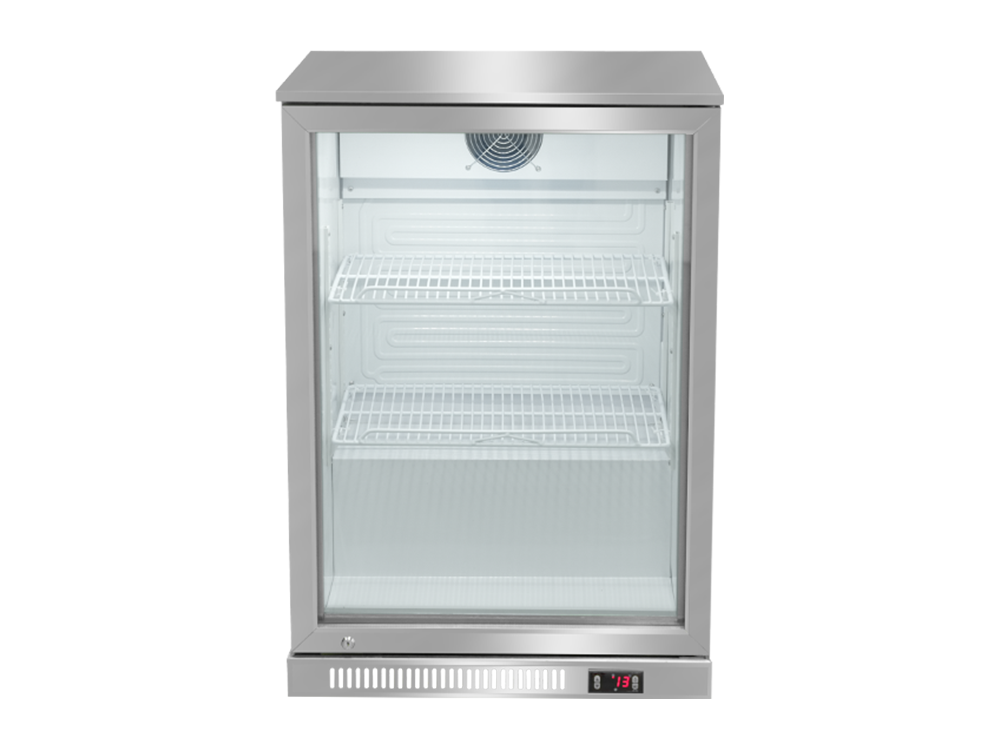 Stainless Steel Back Bar Coolers for Beverage DisplayFor bar and restaurant beverage storage and display, compare stainless steel back bar coolers with one-, two-, or three-door layouts and sliding-door options.View Product →
Procurement Checklist Before You Place a Container Order
Four items belong in writing before a purchase order goes out: the ambient rating, the certification list, the spare-parts plan, and the production and shipping schedule. Each one is cheap to confirm at quotation stage and expensive to fix after the container has sailed.
- Pin the ambient rating to a number. Ask for the temperature the cabinet holds at 90°F and 100°F ambient with a full load, not the thermostat range.
- Collect certification evidence, not claims. Request certificate numbers and the model list each certificate covers, plus test reports for energy consumption.
- Ask how recovery is verified. A supplier with a test lab can report pull-down and recovery figures; a trading company can only repeat the brochure.
- Confirm the spare-parts list and lead time. Gaskets, fan motors, controllers and thermostats should be orderable as separate line items for the life of the cabinet.
- Lock production and shipping dates in the contract, including the port of loading and the inspection point before the container is sealed.
For importers, factory capacity and port access decide landed cost as much as unit price does. Zhejiang Xingbao Electrical Appliance Co., Ltd., which manufactures under the Xingbao brand, runs a 50,000 square meter production floor with an annual capacity of 300,000 refrigeration units across two industrial bases, holds CCC and CE certification alongside roughly 20 patents, and ships through Shanghai and Ningbo. Because beer cabinets, ice makers and back bar coolers are built on shared lines, a mixed container can be filled from a single supplier instead of three.
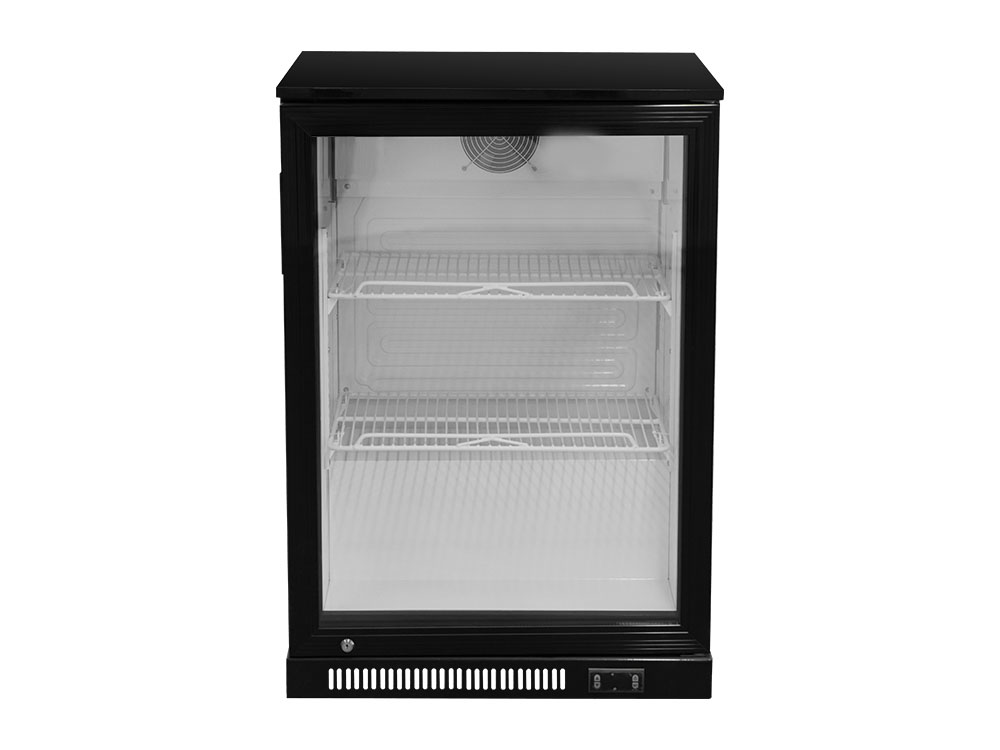 Spray-Coated Back Bar Coolers with Hinged or Sliding DoorsFor importers and bar beverage programs, these spray-coated back bar coolers come in single-, double-, and three-door models with hinged or sliding doors.View Product →
Frequently Asked Questions About Commercial Beverage Refrigerators
What temperature should a commercial beverage refrigerator hold?
Between 34°F and 38°F suits most packaged drinks: it keeps carbonated products from foaming on opening and slows flavour loss after a bottle or keg is opened. Food-safety rules in the United States set 41°F as the ceiling for cold holding, so a cabinet that runs at 40°F under load has no margin left for a busy shift.
Can a residential beverage fridge be used behind a bar or in a shop?
It will run, but the warranty usually will not survive the change of setting. Household units are rated for 70°F to 80°F ambient, carry no NSF/ANSI 7 listing, and use a light-duty compressor that ends up running continuously. Expect one to three years of service in a commercial setting against eight to twelve for a commercial cabinet.
How much ventilation space does a beverage refrigerator need?
Two to four inches at the rear and sides is the usual requirement for cabinets with a side-drawing condenser. Front-breathing models can be built in with tighter side clearance because air enters and leaves through the front grille. Never place a cabinet beside an oven, fryer or dishwasher that pushes heat into the compressor compartment.
Which certifications should an imported beverage cooler carry?
CE marking for the European Union, CCC for the Chinese market, and NSF/ANSI 7 or a UL or ETL listing for food service in the United States, plus energy reporting where the model falls under the commercial refrigeration test procedure. Ask for the certificate numbers and the covered model list rather than a logo printed on a brochure.
The cheapest beverage refrigerator is the one that still holds 38°F on its fourth summer. Price the ambient rating, the recovery time and the spare-parts plan before you compare invoice totals.
Related News

Looking for Reliable Partner?
We are committed to becoming your most trusted partner.
Contact info.
 +86-153 0659 4509
 +86-(0)573-8796 5558
 zjxingbao@gmail.com
 No. 10 Baisha Road, Lianhang Development Zone, Chang'an Town, Haining City, Zhejiang China 314423
Mobile QR Code
Copyright © Zhejiang Xingbao Electrical Appliance Co., Ltd. All Rights Reserved. Custom Commercial Refrigerator Factory
