

 en
 English
 中文简体
 Español
 عربى
Beverage Display Cooler: Why Recovery Time and Defrost Logic Drive Sales
 2026.11.04
 Industry News
A beverage display cooler is judged in the ten seconds after the door closes, not in the showroom. If the front row does not return to 3 °C within about twenty minutes of a restock, the cabinet is quietly losing sales every day it stays on the floor.
Most buyers shortlist a beverage display cooler on capacity, glass area and price. None of those three decide how the unit behaves in a convenience store at 32 °C ambient with the door opening sixty times an hour. What decides it is evaporator surface area, gasket condition, defrost logic, and whether the compressor was sized for a pull-down load or only for a steady-state load.
Zhejiang Xingbao Electrical Appliance Co., Ltd. has manufactured commercial refrigeration for 21 years from a 50,000 square metre facility with roughly 300,000 units of annual capacity. The specification decisions below are the ones that repeatedly separate cabinets that sell drinks from cabinets that only store them.
The number to remember: a cabinet that needs more than 25 minutes to recover after a full restock will spend most of the trading day above its target band, whatever the digital display says.
What a beverage display cooler is, and the three jobs it must do at once
A beverage display cooler is a self-contained refrigerated cabinet with a transparent or open front that holds packaged drinks inside a fixed temperature band while keeping every facing visible and reachable for self-service purchase.
That definition hides three jobs, and a specification that optimises only one of them fails on the sales floor.
- Hold the band. Soft drinks, bottled water and packaged beer sit between 2 °C and 8 °C, while dairy-based drinks and ready-to-drink coffee need the cold end of that range.
- Recover fast. Restocking 24 bottles at 24 °C is the largest thermal load a merchandiser sees all day, and recovery inside 20 to 30 minutes keeps the front row sellable.
- Merchandise by itself. Glass clarity, shelf pitch and LED colour temperature decide whether a shopper reads a label without opening the door.
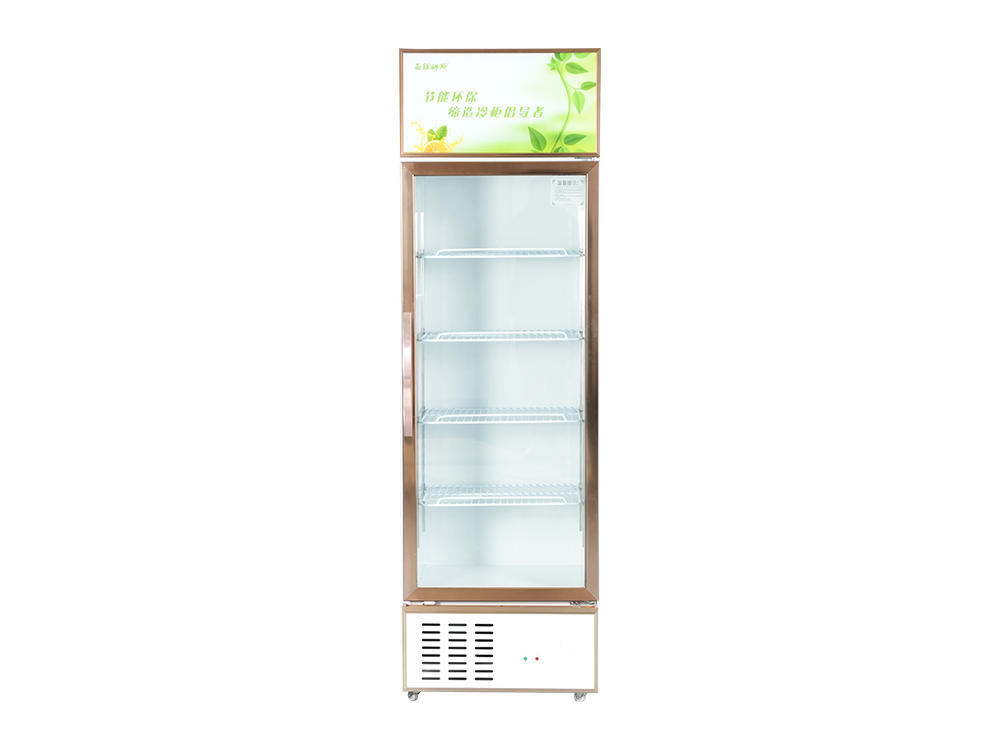 Commercial Beverage Display Coolers and Freezers for RetailExplore customizable beverage coolers and freezers, from single-door showcases to wine cabinets, and compare body styles for retail display.View Product →
The category spans single-door countertop units up to five-door glass front merchandisers, so the first real decision is which body style your sales format actually needs.
Which beverage display cooler type fits your sales format
Choose the cabinet type from how customers reach for the product, then choose the size. A cooler that is correct for a supermarket aisle is usually wrong behind a bar counter, even when both hold the same temperature.
| Cabinet type | Typical band | Front style | Best-fit format | Main risk |
| Glass door upright merchandiser | 2 to 6 °C | Hinged or sliding glass door | Convenience stores, forecourts, hotel lobbies | Gasket wear above roughly 40 door openings per hour |
| Open air merchandiser | 3 to 7 °C | No door, air curtain | Supermarkets, grab-and-go zones | Loses its air curtain when shoppers block the return path |
| Back bar cooler | 2 to 6 °C | Solid or sliding door | Bars, restaurants, cafes | Counter depth and rear ventilation are mis-measured |
| Countertop display | 3 to 8 °C | Glass door or sliding lid | Checkouts, kiosks, hotel rooms | Pull-down too slow for continuous restocking |
| Wine and premium bottle showcase | 6 to 12 °C | Glass door with light control | Restaurants, wine retail | Vibration and UV degrade labels over time |
 Double-Door Stainless Steel Back Bar Cooler SC220LView a 260 L double-door back bar cooler with digital control, auto-defrost, and glass doors for bar and restaurant service.View Product →
Back bar units are the most commonly mis-specified type in the list. A double door stainless steel back bar cooler needs roughly 600 mm of counter depth plus 100 mm of rear ventilation space, and buyers regularly measure only the counter surface.
Temperature band and recovery time: the two numbers that decide repeat purchase
A display cooler sells more drinks when it holds the coldest band the product allows and returns to that band quickly, because shoppers judge the whole cabinet by the first bottle they touch.
Band and recovery are separate specifications. A cabinet can hold 3 °C all day and still sit above 6 °C for forty minutes after a restock, which is exactly the window when a lunch crowd is buying. Coil surface area, fan-forced air distribution and the position of the return air duct drive recovery far more than compressor horsepower does.
Recommended serving temperature by drink category, on a 0 to 12 °C scale
Mixing products in one cabinet always forces a compromise. Carbonated soft drinks and packaged beer sell best between 4 °C and 6 °C, dairy-based drinks need 2 °C to 4 °C, and sparkling wine is damaged below 7 °C. Our guide to the best temperature zone for a display cooler breaks those bands down by product family.
Test recovery with a bottle probe, not the cabinet display. The controller sensor sits close to the evaporator return and typically reads 1.5 °C to 3 °C colder than the core of a bottle on the top shelf.
Glass door or open front: choosing the beverage display cooler front style
A sealed glass door is the more efficient choice for most retail formats, and an open front is worth its energy penalty only where speedy grab-and-go access drives volume.
Glass door merchandiser
- Sealed cooling volume holds 2 °C to 6 °C with the lowest energy penalty
- Uses 15 to 25 percent less electricity than an open front cabinet of similar volume
- Stays cold during short power dips and performs better in warm aisles
- Requires gasket inspection and hinge maintenance on a fixed schedule
Open air merchandiser
- No barrier between the shopper and the product, so impulse conversion is highest at eye level
- Consumes 15 to 25 percent more energy because the air curtain is a weaker barrier
- Performance drops immediately when the return air path is blocked by stock or trolleys
- Suits high-traffic aisles where the cabinet is never obstructed
 Rose Gold GB-500 Two-Door Glass Display RefrigeratorConsider a compact vertical glass showcase with sealed doors and controlled lighting for small retail, convenience, or kitchen display needs.View Product →
Where front-facing premium bottles must look as good as they sell, a vertical glass showcase with controlled interior lighting protects labels and keeps the band stable without the radiant heat that open-front cabinets add to an aisle.
Sizing, shelf pitch and clearance: measure the opening before the cabinet
The cabinet that fits is the one whose door swing, rear clearance and aisle depth all work, not the one with the largest gross volume on the spec sheet.
- Upright merchandiser height: 1,800 mm to 2,000 mm places the top shelf at eye level for a 1,700 mm shopper.
- Cabinet depth: 600 mm to 700 mm, plus 100 mm behind for condenser airflow and 50 mm on each side.
- Shelf pitch: 70 mm to 90 mm for 500 ml PET bottles, 110 mm to 130 mm for 1.5 litre bottles.
- Door swing: a hinged glass door needs 900 mm of clear arc in front; sliding doors need 150 mm of side overlap.
- Aisle clearance: 900 mm minimum for two shoppers to pass, 1,200 mm in a busy grab-and-go zone.
- Floor loading: a loaded five-door merchandiser can exceed 600 kg, so check slab and levelling requirements early.
Energy, refrigerant and what the purchase price does not show
A cheaper cabinet almost always saves money on insulation and coil surface area rather than on the compressor, and the difference shows up as a longer duty cycle and a higher electricity bill for the next ten years.
A+ European energy class achievable with a properly sized coil and 40 mm foam walls
R290 Natural refrigerant with a global warming potential of 3, against several thousand for the gases it replaces
15-25% Typical energy gap between a sealed glass door cabinet and an open front unit of the same volume
Thinner walls and a smaller evaporator force the compressor to run longer for the same result, and they also shorten recovery after a restock. Ask for the foam thickness, the coil surface area and the refrigerant charge in millimetres and grams, not just in marketing language.
Procurement check: request the pull-down curve at your market's summer ambient temperature. A cabinet rated at 25 °C ambient can lose three to four degrees of performance in a 35 °C store.
A six-step procurement sequence that prevents returns
Order in this sequence and most field failures are eliminated before the deposit leaves your account.
- Measure the opening first: door swing arc, rear ventilation gap, aisle width and floor loading.
- Fix the temperature band from the warmest product you plan to sell, not the coldest.
- Count door openings per hour, then decide between a sealed glass front and an open air curtain from that number alone.
- Request a pull-down test at your market's summer ambient temperature rather than at the lab standard.
- Confirm voltage, plug type, refrigerant and controller language for the destination country before production.
- Verify the certification file, including CCC and CE documentation, before the deposit is paid.
Buyers who complete all six steps before ordering rarely need after-sales support beyond a gasket replacement in year three. If you are specifying a mixed order of merchandisers, back bar coolers and island cabinets for one site, send the layout and the temperature bands to our team through the contact page and the configuration can be checked against production capability first.
Frequently asked questions about beverage display coolers
How cold should a beverage display cooler be?
Set carbonated soft drinks, bottled water and packaged beer between 2 °C and 6 °C, and set sparkling wine and delicate white wines between 7 °C and 12 °C. Read the product core with a probe rather than the controller display, because the sensor sits near the evaporator return and reads colder than the shelf.
How many bottles does a single door beverage display cooler hold?
A single door glass merchandiser around 1,300 mm wide typically holds 350 to 450 units of 500 ml PET bottles across four or five shelves. Capacity depends on shelf pitch, on whether the bottom row is merchandised or used as back-up stock, and on whether the cabinet uses wire or solid shelves.
Why does the front row feel warm when the display reads 3 °C?
The most common cause is blocked air distribution rather than a failing compressor. Check that shelves are not overloaded above the supply duct, that the return air path at the bottom of the cabinet is clear, and that the evaporator fan is running at full speed. A short-cycling evaporator fan produces exactly this symptom.
Do open air merchandisers really use more electricity than glass door units?
Yes. An open front cabinet consumes roughly 15 to 25 percent more energy than a sealed glass door unit holding the same product volume, because an air curtain is a weaker thermal barrier than a closed door. The trade-off is faster access, which pays back in high-traffic grab-and-go locations.
Related News

Looking for Reliable Partner?
We are committed to becoming your most trusted partner.
Contact info.
 +86-153 0659 4509
 +86-(0)573-8796 5558
 zjxingbao@gmail.com
 No. 10 Baisha Road, Lianhang Development Zone, Chang'an Town, Haining City, Zhejiang China 314423
Mobile QR Code
Copyright © Zhejiang Xingbao Electrical Appliance Co., Ltd. All Rights Reserved. Custom Commercial Refrigerator Factory
