

 en
 English
 中文简体
 Español
 عربى
Back Bar Cooler Buying Guide: Size, Doors, Temperature, Cost, and Care
 2026.10.28
 Industry News
Stand behind a busy bar and you find the same layout almost everywhere: taps on the counter, glassware overhead, and a low glass-fronted cabinet holding the bottled stock. That cabinet is a back bar cooler, and its only job is to keep bottles and cans at serving temperature within arm's reach of the taps. Choosing the wrong unit shows up as warm beer, blocked aisles, or a compressor that runs all night.
The buying decision narrows to four variables: footprint and capacity, temperature control, door configuration, and running cost. The model-by-model comparison is in our back bar cooler buying guide when you are ready to shortlist.
2-6°Ctarget serving range
600 mmstandard counter depth
3 sstaff reach time
50-100 mmcondenser clearance
What a back bar cooler does that a regular fridge cannot
A back bar cooler is a low-profile, compressor-cooled cabinet built for bottled and canned drinks behind a service counter, and that purpose changes every design decision compared with a general-purpose refrigerator.
Most units stay under 900 mm tall to slide below the bar rail, with a depth matched to a standard 600 mm counter. A regular undercounter refrigerator is taller; neither lets a bartender reach a bottle in the two seconds available during a rush.
Short definition: a back bar cooler is a refrigerated cabinet sized for the space behind a bar counter, engineered to hold drinks between 2°C and 6°C and to survive repeated door openings in a warm, crowded room.
Commercial units use sealed compressors, and the thermostat cycles them to hold a tight band: a unit set to 3.5°C will cycle several times per hour in a 25°C room. Thermoelectric designs belong in hotel pantries, not at a service line.
Size and capacity: match the counter, not the catalogue
Width is the first constraint to measure, and every additional door roughly doubles the usable bottle load.
Gross litres tell you little; the number of bottles on the shelves matters. A 330 ml long-neck bottle is about 60 mm in diameter, so a 430-600 mm single-door cabinet fits 30-50 bottles and a triple-door unit reaches 120-190.
| Configuration | Typical width | Typical height | Typical depth | 330 ml bottles |
| Single-door | 430-600 mm | 700-900 mm | 550-650 mm | 30-50 |
| Double-door | 900-1200 mm | 700-900 mm | 550-650 mm | 70-110 |
| Triple-door | 1350-1800 mm | 700-900 mm | 550-650 mm | 120-190 |
| Double sliding-door | 900-1200 mm | 700-900 mm | 550-650 mm | 80-120 |
A bar pouring 8-12 taps usually covers the bottled lineup with one double-door unit. Venues that rotate seasonal releases pair it with a single-door cabinet; an oversized cooler burns more energy to hold setpoint.
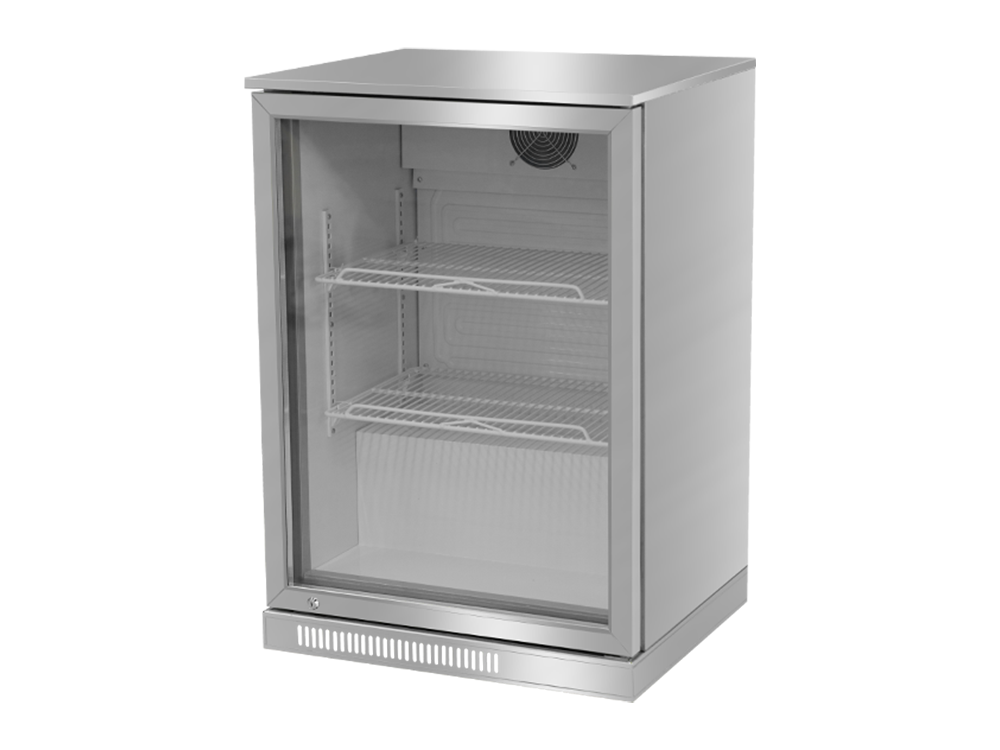 Single-Door Stainless Steel Back Bar CoolerA compact single-door stainless steel beer cabinet with two size options, efficient refrigeration, a lockable door, and optional transparent window. Ideal for bars needing a space-saving cooler for 8-12 taps.View Product →
Measure the space before comparing shelves:
- Hinged units need 110-120 mm of swing space in front.
- Most units run 700-900 mm tall.
- Tall cans need adjustable shelves.
- Leave 50-100 mm behind for condenser airflow.
Sizing rule of thumb: plan 600 mm of cooler width per 30-40 bottles of rotating stock and keep one empty shelf for fast movers.
Stainless steel models are the standard for wet bars because the exterior wipes clean and resists corrosion from spillage.
Temperature performance: holding 2-6°C under bar heat
A back bar cooler must hold 2-6°C at the warmest point on a shelf, not just at the thermostat sensor.
Most operators set the controller to 3.5°C. That keeps lager and cider in the 3-5°C range drinkers expect, leaves margin for a 1-2°C swing, and stays above the freezing point of low-alcohol mixers.
Compressor-cooled
Holds setpoint in 30°C ambient; recovers in 15-30 minutes after restocking; service life of 5-10 years; draws 1.5-3.5 kWh per day.
Thermoelectric
Quiet and cheap; copes with 20-30 bottles in a guest pantry; loses control above 25°C ambient; not built for repeated door openings.
Fan-assisted air circulation keeps temperature uniform from top shelf to bottom, which matters when every slot holds a different brand.
Temperature rule of thumb: 3.5°C for lager, 4.5°C for craft ale and wine, and always test recovery with the shelves loaded warm.
Door logic: glass, solid, hinged, or sliding
Door style decides both the merchandising effect and the energy bill, and the right choice differs between a front bar and a wait station.
Glass-fronted cabinets turn the cooler into advertising: bottles lit from inside sell product without a word from staff. The trade-off is heat ingress, so the unit defrosts more often. A solid door cuts energy use by 10-15% and protects light-sensitive beer.
Glass door
Boosts impulse sales; standard for bottled beer, wine, and mixers; expect more defrost cycles and a higher energy draw.
Solid door
Lower running cost; keeps light away from hop-forward beer; stainless finishes suit kitchen and prep zones.
| Factor | Hinged door | Sliding door |
| Swing space | 110-120 mm in front | None; panels move sideways |
| Access during a rush | Full-width opening | Half opening at a time |
| Maintenance | Simple gasket replacement | Track needs weekly cleaning |
| Best position | Back bar with room to open | Narrow counters and wait stations |
In a narrow bar, sliding doors win because staff can grab a bottle with the door half open and the cold air stays inside. The track needs a weekly wipe-down.
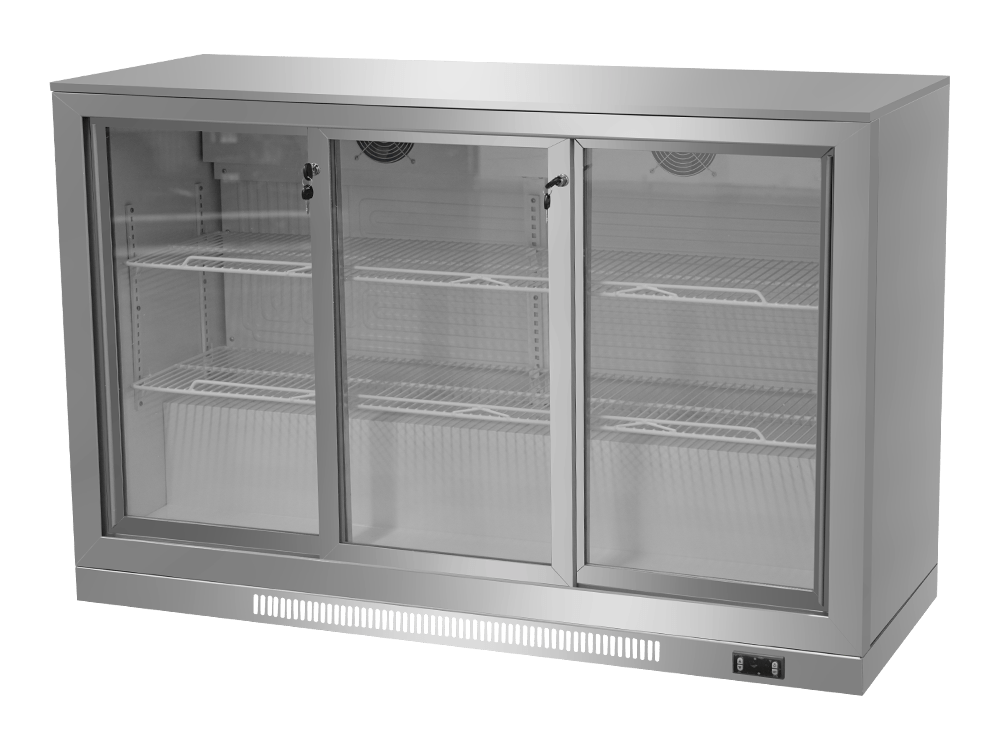 Three-Sliding-Door Stainless Steel Back Bar CoolerThis three-sliding-door stainless steel cooler offers wide access while retaining cold air, making it practical for narrow bar layouts. Two size options and smart temperature control support high-volume drink storage.View Product →
Stainless steel changes the decision. A stainless steel back bar cooler with hinged doors is the workhorse of high-volume bars: the exterior takes constant contact, and the interior cleans faster than a plastic liner.
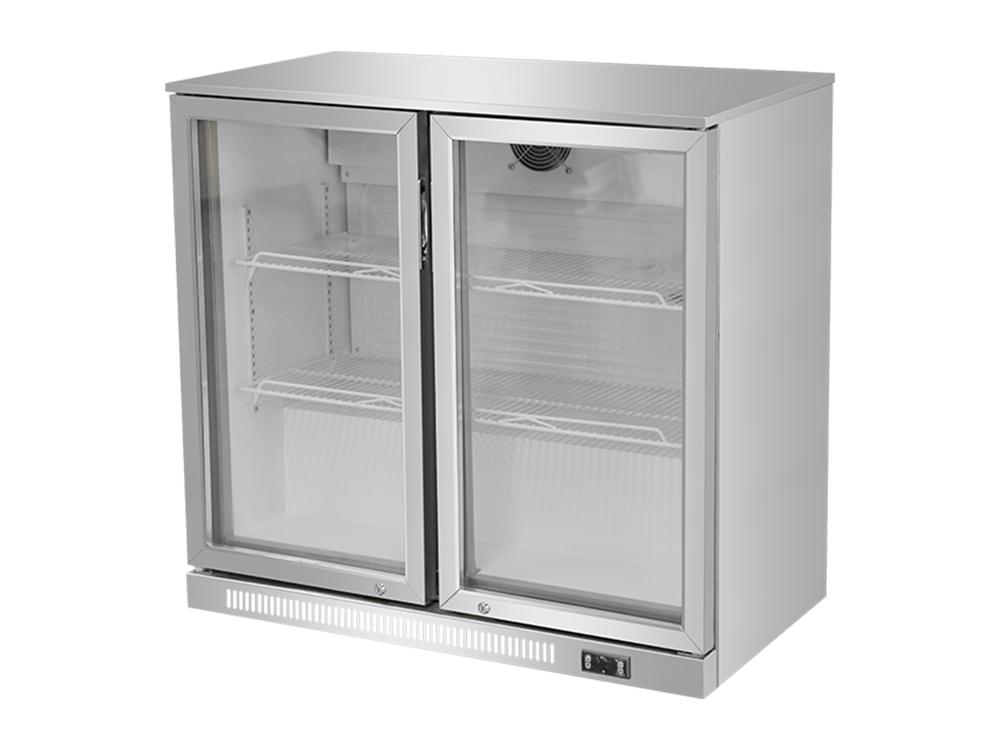 Double-Door Stainless Steel Back Bar CoolerA durable double-door stainless steel back bar cooler with spacious interior and efficient refrigeration. Independent doors help maintain temperature while providing flexible access, suited for busy commercial settings.View Product →
The five specs that predict long-term cost
Five numbers on the spec sheet, climate class, daily energy draw, refrigerant, insulation thickness, and noise, predict the cost of ownership better than the sticker price.
Climate class states the maximum ambient temperature the unit can hold; for bar duty, choose at least 32°C. Daily energy draw at 25°C separates an efficient cabinet from a power-hungry one, and R290 refrigerant keeps the carbon footprint low.
| Spec | What it tells you | Value to look for |
| Climate class | Maximum ambient temperature the unit can hold | N rating or 32°C minimum |
| Daily energy draw | kWh per day at 25°C ambient | 1.5-2.5 single-door; 2.5-4 multi-door |
| Refrigerant | Efficiency and compliance | R290 (propane), low GWP |
| Insulation | How long the cold stays during openings | High-density polyurethane foam |
| Noise | Sound pressure at 1 m | 42-50 dB(A) is normal |
Typical daily energy draw by configuration in kWh at 25°C ambient
Installation, ventilation, and the weekly check
Give the condenser 50-100 mm of clearance on every side and clean it twice a year; that single habit prevents most compressor failures in commercial back bar coolers.
When the condenser coil is buried in dust or pressed against the wall, discharge pressure rises, the compressor runs hot, and the unit short-cycles until the overload protector trips. That can kill a compressor within two years.
A 10-minute weekly check keeps the cabinet on temperature:
- Wipe the door gasket; a loose gasket can add 0.3-0.5 kWh per day.
- Vacuum the condenser grille; dust hides the fins and blocks airflow.
- Read the digital controller; a flashing error code means trouble.
- Clear the interior air vents; crates block the cold-air return path.
Leveling matters too: the front feet should tip the cabinet back about 5 mm so condensation runs toward the drain pan.
Maintenance formula: clean the condenser every 6 months, replace a worn gasket within one week, and keep stock 2 cm off the back wall.
What a back bar cooler costs to run per month
Daily energy draw, not the purchase price, decides what a back bar cooler costs to run.
Take a 2.4 kWh per day double-door unit at $0.15 per kWh: 2.4 x 365 x 0.15 = $131 per year, about $11 per month. A 3.5 kWh per day unit costs $192 per year, so the efficient cabinet saves roughly $300 over five years.
Ambient temperature is the biggest controllable factor: every 5°C above 25°C raises energy draw by 10-15%.
Realistic monthly figure: $11 for a double-door back bar cooler at $0.15 per kWh, about $22 at $0.30 per kWh.
Factory-direct sourcing changes the arithmetic. Seeing how the cabinets are built, insulation thickness, steel gauge, and condenser placement, is worth the trip, and factory visits are easier to arrange than most buyers expect. Zhejiang Xingbao Electrical Appliance Co., Ltd., a 21-year-old manufacturer with 300,000 units of annual capacity, produces stainless steel back bar coolers under the XLMS and Xingbao brands and handles custom specification requests directly.
Choose the cabinet sized to the counter, set it between 2°C and 6°C, give it 50-100 mm of airflow, and clean the condenser on schedule. Those four decisions separate a unit that runs a decade from one that gets replaced mid-season.
Back bar cooler FAQ
What temperature should a back bar cooler be set to?
Set the controller to 3.5°C for a mixed lineup of lager, cider, and wine. Drop to 2°C for sparkling wine or busy rush hours; raise to 4.5°C for hop-heavy craft ale.
How much clearance does a back bar cooler need?
Commercial units need 50-100 mm of free space at the rear and sides, and hinged models need about 110-120 mm in front so the door opens fully. Level the unit with a slight backward tilt so condensation drains.
How many bottles fit in a back bar cooler?
A 430-600 mm single-door cabinet holds 30-50 regular 330 ml bottles; a double-door holds 70-110; a triple-door holds 120-190, depending on shelf count and bottle diameter.
How long does a commercial back bar cooler last?
With a sealed compressor, regular condenser cleaning, and gasket maintenance, a commercial back bar cooler typically runs 5-10 years. The most common failure is a blocked condenser, not the compressor itself.
Related News

Looking for Reliable Partner?
We are committed to becoming your most trusted partner.
Contact info.
 +86-153 0659 4509
 +86-(0)573-8796 5558
 zjxingbao@gmail.com
 No. 10 Baisha Road, Lianhang Development Zone, Chang'an Town, Haining City, Zhejiang China 314423
Mobile QR Code
Copyright © Zhejiang Xingbao Electrical Appliance Co., Ltd. All Rights Reserved. Custom Commercial Refrigerator Factory
